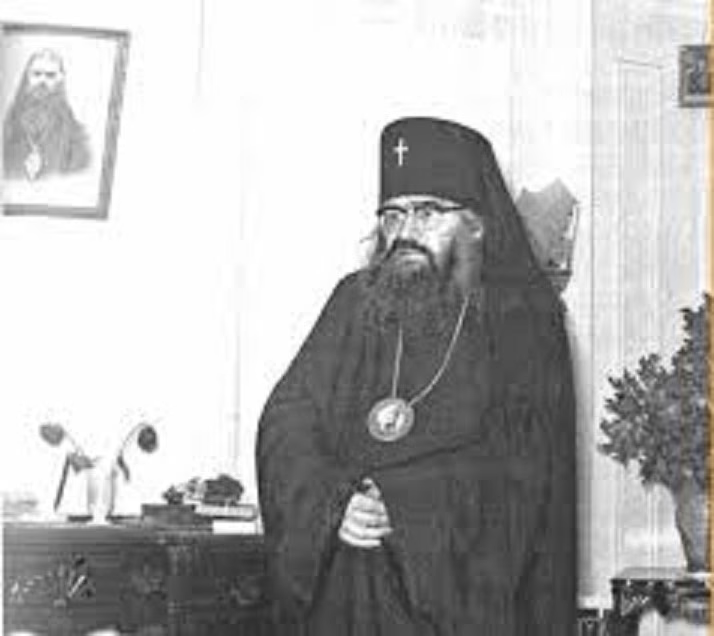
Saint John Maximovitch
BY LAMBROS K. SKONTZOS, Theologian – Professor
Russian Orthodoxy has a great cloud of saints to present, which adorns the hagiological firmament of our Church. We have a particular manifestation of saints in more recent times, when the Russian Church had entered its well-known historical trials. One of the eminent contemporary Russian saints is Saint John Maximovitch, Bishop of Shanghai and San Francisco, of the Orthodox Russian diaspora.
He was born on June 4, 1896, in the village of Adamovka in the province of Kharkov in Southern Russia. His baptismal name was Michael. His parents were named Boris and Glaphyra and were descendants of the renowned aristocratic and pious Maximovitch family. Indeed, one member of the family, John Maximovitch, was a renowned Hierarch, Bishop of Tobolsk, who became a saint (commemorated on June 10) and whose venerable relic remains incorrupt in the city of Tobolsk.
His pious parents raised him with faith in God and reverence for Orthodoxy. But he himself also showed from a young age an unusual love for God and a strong inclination to live the ecclesiastical life. Although sickly, he ate little and kept all the fasts of the Church. He liked to frequent the Church, and when he played with his toy soldiers he dressed them as monks. He prayed with compunction for many hours, standing upright. He liked to collect icons and religious books and to read the lives of saints. He took care to recount them to his four younger siblings. With himself he was very strict and observed with exactness the ecclesiastical and national traditions. His French governess was so impressed by her pupil Michael's living of Orthodoxy that she was converted and baptized Orthodox!
In 1907, at the age of eleven, his parents sent Michael to study at the Military School of the city of Poltava. There he came to know and became attached to the venerable Bishop Theophan of Poltava, who inspired Michael and exerted great influence on his soul. He instilled in him a strong faith in God. During a certain military parade, as he was passing in front of the city's Cathedral, the young Michael made the sign of the cross, something which military protocol forbade during the parade. His fellow students mocked him and the instructors decided to punish him. But Prince Constantine, who was the overseer of the school, proposed that he not be punished, because he discerned in him a deep religious faith.
In 1914 he graduated from the military academy, but because he did not want to follow a military career, he expressed the desire to study Theology, at the Theological School of Kiev. His parents objected, and so he was compelled to study law, and thus he enrolled in the Law School.
In 1917 the October Revolution broke out in Russia and the country was seized by the atheist Marxists. In 1921 a civil war broke out, which forced many Russians to flee abroad. Together with them, Michael's family also left and settled in Yugoslavia. Michael enrolled in the Theological School of Belgrade, while at the same time he sold newspapers to make a living.
Within him was born the desire to become a clergyman and to serve the Church of Christ. Thus in 1924 he was tonsured a reader by Bishop Anthony of the Russian Church in Belgrade. Two years later, in 1926, he was ordained a deacon and tonsured a monk, with the name John, at the Holy Monastery of Milkovo, and subsequently he was ordained a priest.
In 1934 he was appointed a professor at the Seminary in the city of Bitola in Serbia and subsequently he was elected Bishop of Shanghai. At first he refused, because of a certain problem with his speech. But in the end he was persuaded, because he considered this a calling from God, to work for the evangelization of the vast idolatrous country of China. On November 21, 1934, he arrived in Shanghai, finding an unfinished church and a small flock divided by ethnic strife. He threw himself with passion into the struggle to organize the Orthodox Church. He managed to unite the faithful, completed the church, and founded an orphanage, in the name of Saint Tikhon of Zadonsk, for the orphans of the area who were suffering and dying from abandonment. He gathered up more than 3,500! He celebrated the Liturgy, preached, and converted a multitude of people to Orthodoxy.
But the communist revolution broke out and a relentless persecution against religion began. Saint John was forced to flee, taking with him the orphans as well, to the Philippines and later to America and Australia. In 1951 he is settled in the U.S.A. The Russian Bishops there sent him to the Diocese of Paris and Brussels. John accepted. There he accomplished a remarkable pastoral work, making Orthodoxy known in Europe. There he was given the opportunity to study the Fathers and to write the lives of the Saints from before the separation of the papacy from the Church. For the first time the Europeans came to know the saints of the Orthodox East and Orthodox spirituality.
In 1962 he returned to the U.S.A. and was elected Bishop of San Francisco, of the Russian Church Abroad. There he accomplished an admirable pastoral work and his virtues and his holiness became known. On July 2, 1966, he accompanied to Seattle, U.S.A., the miraculous icon of the Panagia of Kursk. After the conclusion of the Divine Liturgy, he remained in the Sanctuary praying for three hours. Then he withdrew to his room to rest. He sat down in an armchair. There he calmly gave up his last breath. His sanctified soul flew to heaven to meet Christ, whom he had so loved and longed for in his earthly life. Later it became known that the saint had foreseen his death. A few days earlier he had sent a letter to the nuns of Lesna in France, sending them his last blessings. His sacred remains were transferred to the Cathedral of San Francisco, which he himself had completed. An all-night vigil took place, with the participation of thousands of faithful. Then a procession of the Relic took place, which was lifted up by the orphans he had brought from Shanghai. He was buried in the chapel in the basement of the Church, beneath the Sanctuary, on the afternoon of July 7.
In the autumn of 1993 the Synod of Bishops of America, under Archbishop Anthony of San Francisco, carried out the exhumation and found his sacred relic in wondrous incorruption! On July 2, 1994, his canonization took place and it was ordained that his memory be honored on July 2.
Saint John, because he traveled frequently by airplane, was proclaimed the patron of those who travel by air.