Illness and Its Christian Healing – Getting to Know the Holy Unmercenaries, the Physician-Saints of Our Church
By Archimandrite Kyrillos Kefalopoulos
B.A. Hist., Th.M., Ph.D.
Human beings, especially in today’s society, have to face many problems, afflictions, and sorrows that torment them, illnesses and pain that afflict both their bodily health and their psychological and mental balance.
Medical science tries, with medicines and methods of treatment, to cure the illnesses that afflict human beings, while other sciences, such as psychology and psychiatry, struggle against the mental illnesses which, especially today, seem to preoccupy modern man more and more. Yet the problem of illness and pain is broader, with many dimensions and ramifications – bodily, spiritual, psychical – which scientific approaches cannot fully cover, since these usually remain at a superficial consideration of things, unable to enter into the deeper recesses of the psycho-spiritual dimension of the human person.
Pain and illnesses seem to be deeply rooted in and identified with human nature. The Lord forewarned His disciples that ”in the world ye shall have tribulation” (John 16:33). The Apostle Paul extends the existence of pain to the whole of creation, which groans and suffers together with man (Rom. 8:22). At the same time, however, he says that we too must pass through this stage of afflictions: ”we must through much tribulation enter into the kingdom of God” (Acts 14:22).
Through this purifying process of pain, which leads to the kingdom of Heaven, seen in this light, pain acquires another, redemptive dimension, which to many people seems incomprehensible.
In the Old Testament, where the journey of the people of God, Israel, is described – whose historical course passed through great national and religious trials – persons are mentioned who were harshly tested.
From the beginning, pain and illnesses appear as identical with the lot of the human race, an inseparable part of the fallen condition experienced by the first-created after their expulsion from Paradise. With sorrows and groanings, with toil and illnesses, human life would henceforth be (Gen. 3:16-19). Man is harshly tested; his whole being suffers. The suffering person utters a cry of despair that issues from his pained heart, together with a feeling of pain and abandonment. Yet, through the trial of illness the measure of our faith is ultimately tested, and this can also work in a positive way, as an occasion for conversion and a strengthening of faith.
Christ upon the Cross is led to humiliation and death, taking upon His shoulders human weaknesses and sins; through His life and His death Christ becomes wholly a sacrifice of atonement and redemption for human pain (Isa. 53:2-12). Christ came for suffering and sick people. These He places at the center of His ministry – the blind and the lame He healed, lepers He cleansed, the dead He raised (Matt. 11:5). To all these the Lord addresses an invitation: ”Come unto me, all ye that labour and are heavy laden, and I will give you rest” (Matt. 11:28).
Many times Christ had spoken and forewarned of the necessity of pains and afflictions, of the cross that each one must take up (Luke 9:23). This is the narrow and afflicted way that leads to the kingdom of Heaven. Through pains and afflictions man will pass, in order to gain the heavenly Kingdom (Luke 9:23). Yet there is the final assurance of Christ that ”in the world ye shall have tribulation: but be of good cheer; I have overcome the world” (John 16:33), and the promise of the sending of the Holy Spirit, the Comforter, who will support the faithful in difficult moments (John 16:13).
The experience of pain and afflictions (bodily and spiritual, as well as illnesses) acquires for the Christian spiritual and soteriological dimensions, since illness, within the framework of the Christian faith, becomes a source of patience and consolation – ”whether we be afflicted, it is for your consolation and salvation, which is effectual in the enduring of the same sufferings which we also suffer…, our hope of you is stedfast, knowing, that as ye are partakers of the sufferings, so shall ye be also of the consolation” (2 Cor. 1:6-7).
Through this apparent weakness, the tested and afflicted Christian draws strength, faith, and hope. This experience is expressed by the Apostle Paul: ”for my strength is made perfect in weakness… for when I am weak, then am I strong” (2 Cor. 12:9-10). The Church prays to the great Physician of our souls and bodies, the Lord Jesus Christ, to deliver us from pains and illnesses (cf. the prayers for health, the Sacrament of Holy Unction). Through the painful way, faith is tested and strengthened by the hope and love of God (Rom. 5:3-8).
The healing work of Jesus, with the many instances in the New Testament of the miraculous cures which the Lord accomplished – always as a consequence and result of the strong faith of those seeking healing – served to strengthen the faith of people and as a sign of the presence of divine grace among the world. The healing work of Christ was continued within the Church by the Apostles and the Saints, especially those Saints who received the appellation Unmercenaries (Anargyroi).
Our Church recognizes twenty Holy Unmercenaries who, having studied the science of medicine, combined the work of healing with the spreading of faith in Christ, the provision of medical services, and philanthropy and care for the poor, since they offered their knowledge without receiving payment (without silver – without “argyrion” – and hence they were called Unmercenaries). Some of them are more widely known, others not particularly known to the faithful, yet all of them without exception were shown to be bearers of divine grace, making use of their knowledge and the gifts of the Holy Spirit, healing bodily illnesses, healing the wounds of the soul, strengthening the humble and infirm among their fellow men in their illness, in the trial of their faith and their patience, following the evangelical command ”freely ye have received, freely give,” and always acting for the glory and praise of the Name of God. It is these Physician Holy Unmercenaries of our Church whom we shall try to approach and to come to know.
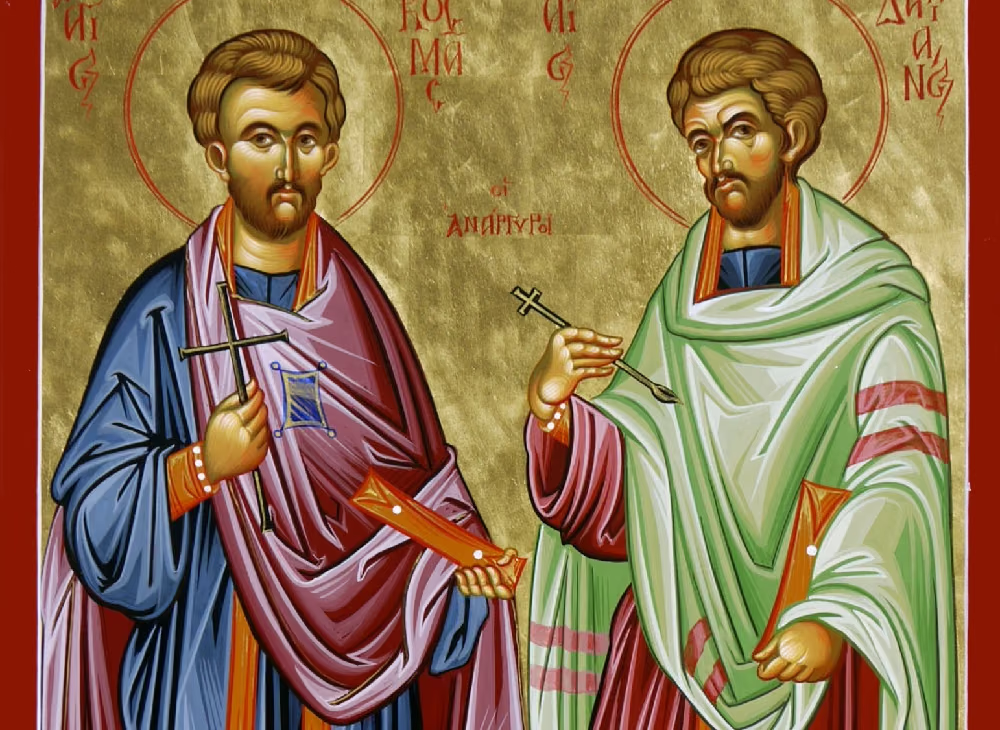
The best known of the Holy Unmercenaries are the brothers Cosmas and Damian. Under these names our Church honors three pairs of brothers. On the 1st of July the brothers Cosmas and Damian originating from Rome are commemorated, physicians by profession, who lived in the times of the Emperor Nero. Saints Cosmas and Damian offered their medical services free of charge to all, and where science did not suffice, by invoking the name of Christ they healed the sick. Their fame spread, and out of envy other physicians denounced them as Christians. But when they were set free to practice medicine, then another physician led them by deceit onto a certain mountain, ostensibly to gather medicinal herbs, and there he cast them down to their deaths.
On the 1st of November our Church honors another pair of brothers, Holy Unmercenaries likewise named Cosmas and Damian, originating from Asia Minor. Their mother, Theodote, was widowed early and devoted herself to the Christian upbringing of her children. The two brothers Cosmas and Damian studied and distinguished themselves in medicine, practicing their science as a ministry and an offering to their neighbor, combining the healing of bodies with the Christian care of souls. Payment they did not accept, for they awaited the heavenly reward. They reposed in peace at a ripe old age.
A third pair of Holy Unmercenaries, Cosmas and Damian, together with their other three brothers Leontios, Anthimos, and Euprepios, originated from Arabia. The five brothers distinguished themselves for their good works and their Christian zeal, by which they drew many to the faith. They were denounced as Christians, arrested during the persecution of Diocletian, and put to death by beheading. The Church honors the memory of the five brothers on the 17th of October.
Another pair of Holy Unmercenaries, Saints Cyrus and John, likewise suffered martyrdom in the great persecution of Diocletian. Cyrus came from Alexandria in Egypt, and John from Edessa in Mesopotamia. Saint Cyrus left Alexandria and went to Arabia to lead a monastic life. God granted him the power to work many miracles. His fame spread and drew John near to him, who remained with him living as a monk in the same monastery. During the persecution of Diocletian, Saints Cyrus and John left the desert and hastened to encourage the arrested Christian women to endure their martyrdom. They were arrested and suffered martyrdom by beheading. Saint Cyril of Alexandria saw to the translation of the relics of the two saints and raised a magnificent church in Alexandria, where many Christians and idolaters came as pilgrims and were healed miraculously by the Holy Unmercenaries Cyrus and John. Their memory is honored on the 31st of January.
To the company of the Holy Unmercenaries belongs Saint Tryphon (1st of February), from Lampsacus in Phrygia, who, although he was not a physician, had the divine gift of healing illnesses. His fame reached as far as the Emperor Gordian, who summoned him to Rome to heal his daughter. Saint Tryphon cured her, but he refused the royal honors and gifts, and returned to his homeland. Later, during the persecution of Decius, Saint Tryphon was arrested, tortured, and met a martyr’s end. The wonderworking grace of Saint Tryphon extends not only to human beings, but also to all of nature, animals, fields, and crops, and for this reason cultivators invoke him to protect their animals and harvests.
On the 6th of February the Church honors the martyr Julian who, a physician by science, originating from Emesa in Syria, when he saw the bishop of the city, Silvanus, being led to martyrdom, hastened to strengthen him, and was immediately arrested and put to death (late 3rd century, under the Emperor Numerian).
On the 11th of May the Church honors the hieromartyr Mocius, originating from Rome and of noble lineage, a priest in the Church of Amphipolis in Macedonia. His preaching against the idols and his exhortations to Christians to abstain from the idolatrous festivals brought him into conflict with the proconsul Laodicius, who publicly summoned him to sacrifice to the idols. Mocius, on the contrary, overturned the idolatrous altar. He was arrested, cast into a furnace of quicklime, and came out unharmed. Later, he was thrown to wild beasts to be torn apart, but again the Grace of the Most High protected him. He was led in bonds to Byzantium, where they beheaded him. These things took place under the Emperor Diocletian, a great persecutor of the Christians. In Constantinople, Constantine the Great raised a magnificent church in honor of the hieromartyr Mocius, where he deposited his precious relic.
On the 20th of May, the memory of the martyr and healer Thallelaios, from Lebanon, a physician by profession. In one of the persecutions against the Christians he was arrested, and they hung him upside down by the ankles, and beheaded him.
On the 27th of June the Church honors Saint Sampson the Hospitable, originating from a wealthy and noble family. He settled in Constantinople, where as a priest and physician he developed a great philanthropic work. The Emperor Justinian built a great hospice for the strangers, the poor, and the sick of the Reigning City, and appointed Saint Sampson responsible for the management of the hospice (whence he was called ”the Hospitable”).
On the 26th of July, in the great persecution of Diocletian against the Christians of Nicomedia, when Saint Panteleimon was arrested and asked who had catechized him in Christianity, he named the priest of the Church of Nicomedia, Hermolaos, who was immediately arrested and beheaded.
In the same persecution of Diocletian, the Great Martyr and healer Panteleimon was also arrested. He came from Nicomedia in Asia Minor, of a pagan father and a Christian mother. Early on he lost his mother, but he managed to complete the general course of studies and to learn the science of medicine. The priest Hermolaos catechized and baptized him a Christian. Saint Panteleimon provided his medical services to the poor of Nicomedia. God granted him to heal the blind miraculously. When he was arrested he confessed before Diocletian that he performed miraculous cures by the invocation of the name of Christ. They tore the saint’s sides with iron, they burned his wounds with lighted torches, they cast him into a boiling cauldron and to wild beasts, and after God saved him wondrously, Saint Panteleimon suffered martyrdom by beheading on the 27th of July.
The much-afflicted Church of Nicomedia, seat of the Roman Emperor Diocletian, a great persecutor of the Christians, offered thousands of martyrs and confessors of the faith, among them Saint Anicetus (12th of August), who did not hesitate to reprove the deeds of Diocletian. He was arrested and confessed his faith in Christ, was tortured, and burned at the stake.
Also, in the persecution of Diocletian, the martyr Diomedes (20th of August) suffered martyrdom, from Tarsus in Cilicia, a physician by profession, who healed bodily illnesses and calmed the souls of people by spreading the message of the Gospel. He settled in Nicaea of Bithynia as a physician and teacher of the faith. Diocletian ordered his arrest. The soldiers found that he had already delivered up his soul to the Lord, and after they cut off his head from the lifeless body, they carried it to Diocletian.
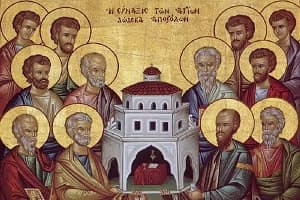
These twenty martyrs of Christ constitute the sacred choir of the Holy Unmercenaries, the Physician-Saints of our Church. On the 17th of October the Church honors the Holy Unmercenaries collectively (the Synaxis of the Holy Unmercenaries).
In addition, the Church has numbered among its Saints women physicians as well, such as the holy women Zenais and Philonilla (11th of October), sisters from Tarsus in Cilicia, who healed without payment with the aid of medical science and the reinforcement of divine grace.
All the Holy Unmercenaries are models of faith, of Christian witness, but also of scientific knowledge, which they acknowledged as a gift of the Lord and put to use for the benefit of the poor, the sick, and the suffering, and not for personal monetary gain or glory and fame. Their knowledge, their deeds, all their actions were guided by the Lord, and they did everything for the glory of the faith and the sanctification of the name of Christ. Their criterion was not fleeting glory or human praise, but eternity. The following troparion sums up the meaning of their mission and of the special calling they received from the Lord.
”Having a fountain of healings, O holy Unmercenaries, ye bestow cures upon all who are in need, for ye have been deemed worthy of the greatest gifts from the ever-flowing fountain of Christ our Savior. For the Lord says to you, as being of equal zeal with the Apostles: Behold, I have given you authority over unclean spirits, to cast them out, and to heal every disease and every sickness. Wherefore, having lived well according to His commandments, freely ye have received, freely do ye give, healing the passions of our souls and of our bodies.”