ASCETICS IN THE WORLD, PART I – Dimitrios Argyropoulos
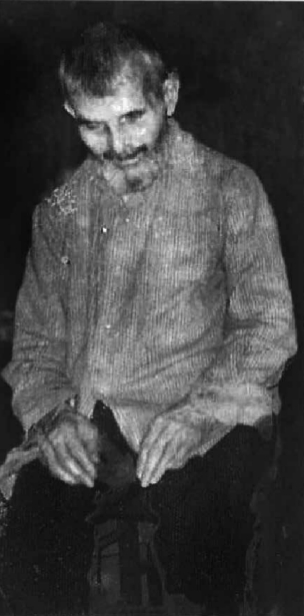
He was born in 1889 in the village of Chryso, near Salona, to Efthymios and Efstathia. At a young age he was orphaned of his father. With his mother Efstathia, his sister Paraskevi and his brother Giannis, they settled in Corinth, and from a young age he worked as an employee in a grocery store. Later he set up his own small shop selling foodstuffs. His fairness in weighing was proverbial. He would put a little extra so as not to shortchange the customer.
His brother was killed in 1918, and his mother, out of her grief, suffered in her mind. His sister too fell ill, because her aunt had beaten her savagely. All day long she would wander the streets with a reed, and in the evening she would come home to sleep.
Mitsos endured his mother's curses and shouting calmly and with a smile. She would throw in his face whatever she found in front of her. He would go, wash himself, and then, smiling, ask his mother if she wanted something. She would curse him with the worst words, saying to him: «Turk, barbarian, wolf», and he would say nothing. She would put a knife to his throat, and he, smiling, would not react.
His neighbors would hear the shouting of his mother until late into the night.
Because Mitsos did not sleep well, during the day he would faint and fall down. On one occasion, from the fall, he suffered a concussion and was hospitalized. He lived a martyric life without complaint. Always smiling, he served mother and sister with patience and love, until his mother fell asleep in the Lord at the age of 105.
He himself lived an ascetic life. He slept on a bed consisting of two planks resting upon two crates. As for clothes, he had only one change for summer and one for winter.
He had only the necessities, and these plain and poor. His food too was frugal and ascetic. He would boil thirteen macaroni, or a cup of legumes, or a few potatoes, and would get through the whole day.
Every day he kept the ninth-hour fast; he always ate only once a day, and some days he ate nothing at all. He did not accept gifts and attentions from others.
He was silent, he spoke few words, only the necessary ones, and he did not condemn anyone. He had written on a piece of cardboard the maxim:
«He who guards his mouth keeps his soul», and he had it posted on the wall.
No superfluous or idle word escaped from his mouth. And as the Apostle James the Brother of God says, «If any man offend not in word, the same is a perfect man, able also to bridle the whole body».
Such a perfect man was also the humble and sparing-of-words Mitsos.
When they asked him something spiritual, he would answer and counsel with delicacy and love. He loved prayer and did not cease to pray day and night. He had grown accustomed to keeping vigil, because his mother's shouting would not let him sleep, and so he prayed for the greater part of the night.
He knew little in the way of letters, he had reached the fifth grade of elementary school; he studied the Holy Scripture much and memorized prayers. Every Thursday he would go to the neighboring homes of people he knew and read them spiritual books.
He was very humble and devoted to prayer, and for this reason many would visit him to seek his counsel. A certain young woman sat examinations at the University and, although she was an excellent student, she did not pass.
She was very distressed and went, together with her mother, to Mitsos to console her.
They all chanted the Supplicatory Canon (Paraklisis) together, and then he said to the young woman:
«My child, do not be distressed, for God is preparing other doors for you».
Indeed, the following year they took her without examinations, as a top student, into the Higher Industrial School of Piraeus.
Within a year a certain young man asked her hand in marriage on the condition that she neither continue her studies nor work. She married, had four children, and remembered the words of Mitsos. She considered that the one door was the school and the other was the marriage.
After the great earthquake of 1981 in Corinth, it was discussed by some of the faithful that: «See, it is people such as Mr. Mitsos who prayed, and so no great damage was done in Corinth». (That is, no people were killed, even though the earthquake occurred at night.)
At Church he was the first to go to attend the Liturgy, and he was always stooped and reverent.
When it was time to receive Holy Communion, everyone would step aside to let him pass. They gave him priority to commune first. He would take the antidoron at the end and leave. When people greeted him, he would not raise his head to look at them, but stooped, he would return the greeting with a faint, serene, sorrowful smile.
After his retirement he devoted himself more to prayer and to worship. He attended without fail all the Liturgies, almost every day if he could, and communed frequently. When there was no chanter, he himself would chant.
The grace of God was evident on his ascetic face. A little child, seeing one day Mr. Mitsos returning from Church, said to his father that Mr. Mitsos had a halo around his head. Once, when he went to receive Holy Communion, a little child said to his mother: «Mama, look, Mr. Mitsos is casting off flames».
An incident once occurred outside his shop, and they called him as a witness at the trial. He was distressed and anxious, because he did not want to swear an oath. When he was called to testify, the Presiding Judge said to him:
«Mr. Argyropoulos, from you we do not want an oath, because we are certain that you will tell us the truth».
His calmness and his forbearance were proverbial.
Someone struck him with his bicycle, knocked him down, and cursed him as well.
Mr. Mitsos got up, dusted himself off and smiled, without saying anything.
He gave much alms in secret. The loans that people asked of him, when they returned them, he would not take back.
He applied the saying «it is more blessed to give than to receive». He helped the sick, the poor and orphans.
He would go at night to poor families with a basket full of foodstuffs, leave them at the door and depart, without being seen. With other brethren they founded in 1924 the Orthodox Christian Association «The Apostle Paul». The poor Mitsos donated the building where a hall for the divine sermon was constructed.
He counseled: «Love everyone and keep your distance from everyone», «Love the enemies who have done you harm», «Let not prayer be lacking to you.
First pray for strangers and for your enemies», «Strive always to do good and never evil»,
«Let us pray for those who accuse us», «God gives many trials and we must have patience».
He underwent surgery three times for an inguinal hernia. In the Hospital during Holy Week, out of obedience to the doctors, he ate meat.
He came close to death and afterwards recovered.
He kept at his bedside a little trunk with one change of clothes for the eternal journey. His savings book with his few savings he gave to a disabled child. During the last two years he did not communicate, and he fell asleep in the Lord at the age of 97 on June 21, 1986, the eve of Pentecost, and on the very day of Pentecost his funeral took place.
In the funeral oration, the late headmaster and former Mayor of Corinth, Mr. Sifis Kollias, began as follows: «Today Corinth buries its saint…».
Indeed, all recognized his virtue and revered him. He was a model Christian who inspired many. Always smiling, calm, humble, patient and silent.
Upon the slab of his grave those who knew him wrote: «Dimitrios Argyropoulos, the merciful».
May his memory be eternal. Amen.
Ascetics in the World, vol. II,
published by the Holy Monastery of Saint John the Forerunner of the Transfiguration,
Chalkidiki
Read HERE the previous related articles
THE VOW OF THE NATION. THE CHURCH OF THE SAVIOR.
The Fourth National Assembly of the Greeks.
Deems itself fortunate to have become the instrument through which the Nation fulfills the most longed-for of its debts, namely to send up its gratitude to God, Who showed so many miracles in order to save it.
Consequently, the Fourth National Assembly of the Greeks votes:
I. When the territorial district of Greece and the seat of its Government are definitively established, and the financial resources of the state permit it, the Government shall order that there be raised at the seat a Church in the name of the Savior.
(ARCHIVES OF THE GREEK PALINGENESIS (National Rebirth), volume 4. The Fourth National Assembly at Argos 1828-1829,
-Second of the National Assemblies, p. 116)
When those responsible remember to fulfill the forgotten and unfulfilled vow of the Nation, and the rebuilding of the Church begins, the proceeds from the sale of the present book will be devoted to a small stone in the Church of our Savior Christ.