Fr. Athanasios Mytilinaios: On the pagan divinatory custom of the Klidonas ritual
By the ever-memorable Archimandrite Athanasios Mytilinaios
Transcribed excerpt from the series of talks "Contemporary Burning Issues"
concerning the pagan divinatory custom of the Klidonas ritual
[…]We now come to a seventh divinatory element, which is very well known and is called the Klidonas. It is especially in the villages that this divinatory practice is employed. What is the Klidonas? It comes from the ancient word "klidon" (of the klidonos), which means rumour, means a divine voice, means prophecy. It is a divinatory game. Most ancient. Most ancient, I tell you. Many such divinatory practices have passed into the life of Christians and have even taken on a Christian colouring.
The Klidon or Klidon, the Klidonas, to put it in plain Greek, as we call it and as our people call it, is in reality a ritual; for it takes place, a whole procedure precedes it before we reach that point. They go, they set out, they expose the contents of the Klidonas to the stars for three nights; it is a vessel with water and so on. This water they take from the spring and it is called "the speechless water," for you must take it and the girl must not speak — it is girls mainly who play this game — none of them must speak, the one who is to fetch it, not at all, nothing; it is called "speechless water" and so forth. There is a ritual. And still worse, that this takes place on the 24th of June, which is the Nativity of Saint John the Forerunner, and that within the songs of the Klidonas they even confuse Saint John the Forerunner… And it is a confused thing, of the kind of which we have not a few within our folklore, which are pagan elements, magical, divinatory, and at the same time also Christian elements. If ever you were to read some book of folklore, you would see such things in abundance, truly in abundance.
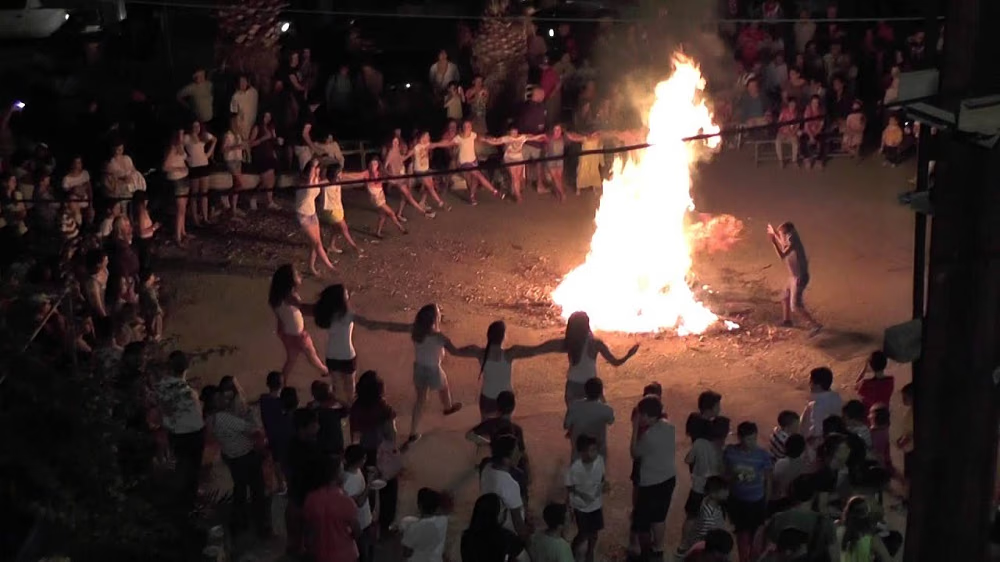
Note, moreover, that in this divinatory game where they throw objects in, where they say something beforehand and then draw out the object — the objects are inside the water, in the speechless water — they say that… they compose a couplet there… — Now whether the couplet is written with an iota or with an upsilon, that… you understand. That is, whether it is an unhappy couplet… Anyway. — And then they draw out an object, and to the one, man or woman, to whom the object belongs, there corresponds also that which was said beforehand. And it is combined, with all these things I am telling you, with the lighting of fires as well. This you know very well, on the 24th of June, the Nativity of Saint John the Forerunner, when they light fires. You should also know that the fires which are lit and which we jump over, and whose ash we often place in our fireplace — first and foremost the May Day wreath is burned. I must tell you that to make the May Day wreath is a sin! Take note of this point. The May Day wreath is a pagan remnant and it is a sin. Indeed, if you wish to see about this May Day wreath and then its use, that we burn it on the 24th of June, you may look in the Pedalion at the 65thον canon of the Sixth Ecumenical Council1. In the footnote which Saint Nikodemos the Athonite adds, on page 279 in the Aster edition, and there he says a great deal.
So then, we burn the wreath, we put other things too to be burned, and afterwards we jump over these fires. This passing through the fires is an old, most ancient manner of purification. That is, to burn there the illnesses, to burn whatever may harm us… — It is so most ancient that it suffices for me to note to you that mention is made of this matter in Deuteronomy, which was written by Moses somewhere around the 14thον, 15thον century: "You shall not pass," it says, "your child through the fire, your boy and your girl." They used to pass their children through the fire. — Because, it says, in this way the evils are burned, the illnesses are burned, as I told you, and moreover they take this ash and place it in the fireplace "for good fortune." "For good fortune"… All these things, you understand, are mixed into our life, and how much we ought to know them, so that we do not employ them and, without realising it, practise idolatry.
TO THE GLORY OF THE HOLY TRIUNE GOD
and with immeasurable gratitude to our spiritual guide, the ever-memorable Elder Athanasios Mytilinaios,
digitisation of the transcribed excerpt: Eleni Linardaki, philologist
SOURCES:
- Transcription of the talk by the hand of the honourable Mr. Athanasios K.
- Talk no. 28η from the series of talks "Contemporary Burning Issues". The title of this particular talk: "The Cycle of Divination. Ornithomancy, Haruspicy, Meteoromancy, Klidonas, Astrology." It was delivered on 9-11-1986. The excerpt comes from 12.51' to 18.45'.
SOURCE OF THE TALK: https://www.arnion.gr/mp3/omilies/p_athanasios/sygxrona_kayta/sygxrona_kayta_028.mp3
1 Canon 65 (65ος) of the Quinisext Ecumenical Council
Τὰς ἐν ταῖς νουμηνίαις ὑπό τινων πρὸ τῶν οἰκείων ἐργαστηρίων, ἢ οἴκων ἀναπτομένας πυρκαϊάς, ἃς καὶ ὑπεράλλεσθαί τινες κατά τι ἔθος ἀρχαῖον ἐπιχειροῦσιν, ἀπὸ τοῦ παρόντος καταργηθῆναι προστάσσομεν. Ὅστις οὖν τοιοῦτόν τι πράξοι, εἰ μὲν κληρικὸς εἴη, καθαιρείσθω· εἰ δὲ λαϊκός, ἀφοριζέσθω. Γέγραπται γὰρ ἐν τῇ τετάρτῃ τῶν Βασιλειῶν: «Καὶ ᾠκοδόμησε Μανασσῆς θυσιαστήριον πάσῃ τῇ στρατιᾷ τοῦ οὐρανοῦ, ἐν ταῖς δύο αὐλαῖς οἴκου Κυρίου, καὶ διήγαγε τὰ τέκνα αὐτοῦ ἐν πυρί, καὶ ἐκλῃδονίζετο, καὶ οἰωνίζετο, καὶ ἐποίησεν ἐγγαστριμύθους, καὶ γνώστας ἐπλήθυνε, καὶ ἐπλήθυνε τοῦ ποιῆσαι τὸ πονηρὸν ἐνώπιον Κυρίου, τοῦ παροργίσαι αὐτόν».