
"We Have Become a Spectacle to the World" (Theatron egenithimen to kosmo)
30 June 2026 · 2 min read
The word “theatron” (theatre) belongs to one of the most remarkable word-families of the Greek language. It derives from the ancient verb “theaomai” ( = to see, to look at attentively) and originally meant the place of viewing — the place from which you look.
◆ From the same root springs an entire family of words:
theatis (the one who looks),
theama (that which is looked at),
theoros (the one who observes),
theoria (the act of seeing),
theoreio (viewing box), theatrikos (theatrical), theatrinos (actor)…
Even the modern “theoro” ( = I think, I believe) carries within it the notion of viewing: to think means, at its core, to look attentively. The transition from viewing to theory — from the eyes to the mind — is one of the most noteworthy semantic journeys of our language.
◆ The word «theatron» conceals a peculiarity: it means at the same time the place (the building) and the spectacle (the performance). In the Hellenistic city, the theatre was not merely a place of entertainment; it was the political, religious and aesthetic lung of the city. In Paul's time, Corinth had a theatre of 14,000 seats. Ephesus, 25,000 — it was inside it that the riot of the crowd described in Acts (19:29) broke out.
◆ The Apostle Paul, who taught in the great urban metropolises (Corinth, Ephesus, Thessalonica, Philippi, Athens), uses images from the Hellenistic urban world — and this sets him radically apart from the language of the Gospels. Jesus speaks to a rural world: seed, harvest, shepherd, sheep. Paul speaks to an urban one: stadium, prize, crown, contest, citizenship, theatre.
◆ Thus, in First Corinthians (4:9), speaking of the apostolic work, in a rare confession of toil and personal anguish, he writes:
❝For I think that God has exhibited us apostles as last of all,like men sentenced to death; for we have become a s p e c t a c l eto the world, to angels and to men❞
Here the word theatron is used in its second meaning: not “place,” but “spectacle.”
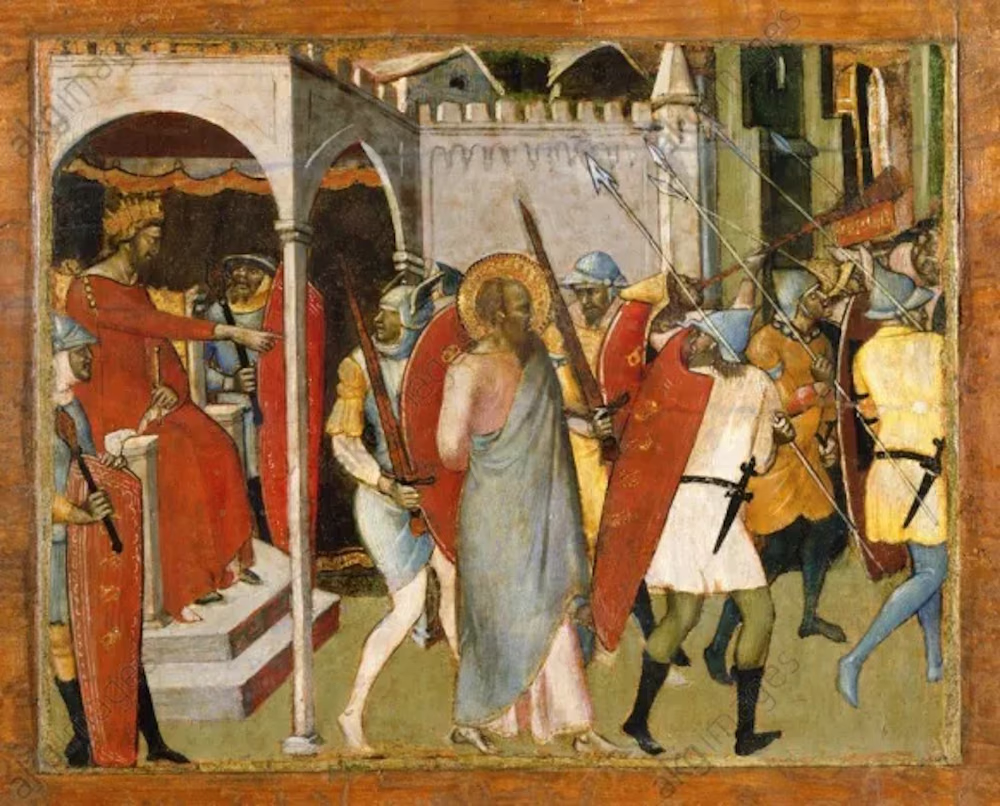
◆ In this very vivid image, the apostles are those who are watched as a spectacle. The «as men sentenced to death» refers to the Roman arena, where the condemned appeared as a spectacle at the end of the games («last of all») — the final and most humiliating act.
◆ And the audience of this theatre are the angels, who marvel, and men, who mock. The whole of reality, visible and invisible, becomes a spectator. The apostle: watched, exposed — with no backstage.
From viewing to theory, and from theory to spectacle: the word «theatron», within a single sentence of Paul, completes its entire cycle.
source: CENTRE OF LEXICOLOGY