Turkey: They presented the Pontic dance as "Turkish" and entered the Guinness Records – The horon, the pyrrhichios and the sera
The presentation of the Pontic dance as a "traditional Turkish dance" at an event in Constantinople has caused an uproar
In Turkey, a Pontic dance which they call horon (choron) was presented as a "traditional Turkish dance," at an event where about 5,000 people danced simultaneously and broke a Guinness World Record.
The event took place in Constantinople, with the participation of thousands of dancers in traditional costumes, organized by the Turkish Dance Federation.
The event was promoted by Turkish media as a great cultural success, with the organizers presenting the dance as part of Turkey's traditional heritage.
This framing has provoked reactions, since the horon, that is the sera, is for Pontic Hellenism one of the most characteristic dances of its historical identity, connected with Pontus, the Black Sea, the Pontic lyra and the collective memory of the Pontic Greeks.
The announcement of the record
About 5,000 people took part in the event, which was officially recorded by representatives of Guinness World Records.
Upon announcing the result, the Guinness World Records representative stated:
"It is my great pleasure to officially announce that the Turkish Dance Federation is the new holder of the Guinness World Records title for the largest traditional Turkish dance."
The phrase "traditional Turkish dance" was precisely the point that caused the greatest stir, since the dance presented as Turkish is inextricably linked to the Pontic tradition.
From the pyrrhichios to the sera and the horon
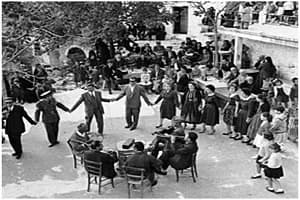
The dance presented in Turkey as a "traditional Turkish dance" is not merely a generic folk dance of the Black Sea. It touches one of the deepest cores of Pontic memory: the relationship of the Pontic dance with the pyrrhichios, the sera and the dance tradition of the Greeks of Pontus.
The pyrrhichios is considered one of the oldest war dances of the Greek world. It was connected with physical readiness, combativeness, rhythm and the discipline of the warrior. It was not a simple dance of entertainment, but a dance of strength, intensity and collective expression.
In the Pontic tradition, the most emblematic continuation of this martial dancing spirit is the sera. The sera is the quintessential Pontic war dance: fast, dynamic, with intense movements, a sharp rhythm and characteristic physical intensity. It is danced in a manner that evokes readiness, endurance and collective cohesion.
For Pontic Hellenism, the sera is not merely a folkloric element. It is a dance of identity. It is connected with the historical presence of the Greeks in Pontus, with the memory of the communities of the Black Sea, with the Pontic lyra, with the refugee associations and with the preservation of a tradition passed down from generation to generation after the uprooting.
The horon, as the dance of the Black Sea region is called today in Turkey, is presented by the Turkish side as a traditional Turkish dance. In essence, however, it is the Turkish version or variant of a dance idiom that has a direct kinship with the Pontic dance tradition and especially with the sera.
The similarities are not coincidental: the circular or group formation, the intense rhythm, the fast movements, the physical intensity and the connection with the musical tradition of the Black Sea point to a common cultural substratum, in which the Pontic Greek presence was decisive.
This does not mean that the horon is not danced today by the populations of Turkey or that it has not been integrated into modern Turkish folk culture. It means, however, that presenting it as an exclusively "Turkish" dance silences the Pontic Greek dimension and the deep historical relationship of this particular dance idiom with the sera and the pyrrhichios.
What the Guinness Records entry means
The Guinness Records entry concerns the scale of the event and the simultaneous participation of the dancers, not the historical or ethnological origin of the dance.
In other words, Guinness World Records certifies that a mass dance performance was carried out that met the rules of the specific record. It is not a historical, folkloric or ethnological committee that rules on who "owns" a dance or what its full cultural identity is.
This is crucial, because the Turkish presentation attempts to turn a numerical record into cultural proof. The fact that thousands of people simultaneously danced the horon in Turkey does not prove that the dance is exclusively Turkish, nor does it nullify its Pontic Greek dimension. It certifies only the scale of participation.
The significance lies elsewhere: when a dance with such a strong relationship to the Pontic tradition, to the sera and to the memory of Pontus is presented internationally as a "traditional Turkish dance," the image produced is culturally charged.
This is not, therefore, a simple folkloric moment. It is an international showcasing which, even if it formally concerns a participation record, in practice reinforces a specific Turkish narrative about the cultural heritage of the Black Sea.
The broader picture
The incident comes at a time when Turkey is investing ever more heavily in cultural diplomacy.
From gastronomy to dances and from Ottoman heritage to the traditions of the Black Sea, Ankara is attempting to project internationally a unified Turkish cultural narrative.
In this narrative, elements that were born or shaped in the multi-ethnic environments of the East, of Pontus, of the Balkans and of Asia Minor are often presented as exclusively Turkish.
The Pontic dance is a characteristic example.
For Turkey, the horon is presented as a dance of the Black Sea and part of the Turkish folk tradition.
For the Pontic Greeks, however, the choron, the sera and the related dance forms are a living part of Pontic identity, the continuation of a long historical presence in Pontus and a symbol of collective memory.
The horon, as it is projected today in Turkey, cannot be severed from this substratum. It is essentially the Turkish variant of a Black Sea dance idiom that has a deep kinship with the Pontic sera and the Greek Pontic tradition.
These two realities are not the same.
It is one thing to recognize that the dance is danced today in Turkey as well, by the populations of the Black Sea, and quite another to present it internationally as exclusively "Turkish," without reference to its Pontic Greek dimension.
The first approach recognizes the complexity of history.
The second simplifies it, nationalizes it and creates justified reactions