SAINT AUGUSTINE, BISHOP OF HIPPO
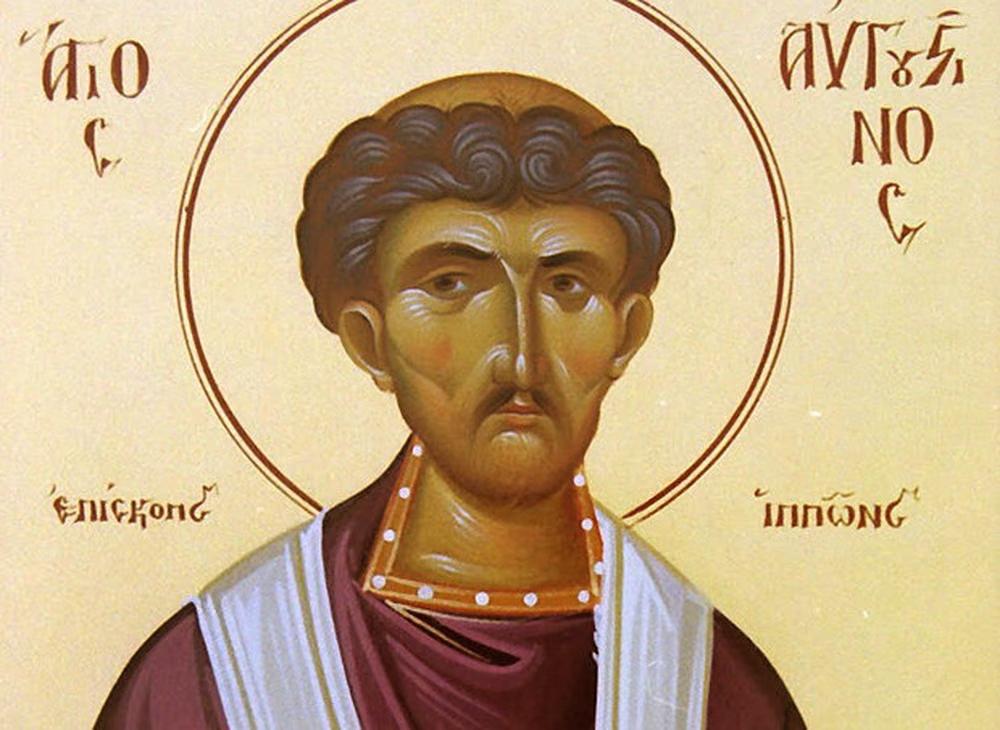
By LAMBROS K. SKONTZOS, Theologian – Teacher
One of the great Fathers and teachers of the ancient Western Church was Saint Augustine, bishop of Hippo in North Africa. He was a great personality who literally left his mark on the human spirit, created theological thought and gave a definite direction to Western civilization.
He was born in the city of Thagaste in Numidia (present-day Algeria) in 354. His father, a noble landowner, was a pagan, unlike his mother Monica, who was a fervent Christian and who took care to instruct young Augustine in the Christian faith. He, however, showed himself to be undisciplined from an early age and refused Holy Baptism.
He displayed unusual intelligence early on and received a serious education. He persistently refused to learn the Greek language, a fact that would later prove fateful for him. At the age of seventeen he was sent to Carthage to study rhetoric. But there he fell in with bad company and began to live a dissolute life. He became attached to a certain Christian woman, with whom he even had an illegitimate son, Adeodatus, in 372. This deeply wounded his pious mother, who shed rivers of tears for the salvation of her son.
He became a fanatical student of Cicero, which led him to turn toward philosophy and the search for truth. Gradually he began to regard Holy Scripture as inadequate, and for this reason he turned to heretical groups. He ended up in the heresy of the Manichaeans, whose dualistic system fascinated the restless young Augustine. The «deification» of evil, as that heresy proclaimed, justified his dissolute life. He remained in this heresy for nine years. He then returned to Thagaste and opened a school of rhetoric. But his time in Manichaeism had deeply wounded his soul, and so he lived in a world of illusions and was spiritually unsatisfied. An important role in this was played by bishop Faustus, who instilled spiritual questionings in his soul. He decided to go to Rome, where he opened another school of rhetoric and associated with renowned philosophers. He began to study Neoplatonic philosophy with passion, in which he thought he had found the truth he was seeking. The asceticism of Neoplatonism drew him away from immorality. There he fell gravely ill. After his recovery he went to Milan, where he transferred his school.
A turning point in his spiritual course was his acquaintance there with Saint Ambrose, bishop of Milan, in 384. His mother Monica had already met with the holy bishop and earnestly begged him to save her child. The holiness, meekness and sweetness of Saint Ambrose won over the unruly Augustine. After a long catechesis, Augustine was converted to the Christian faith. He definitively renounced Manichaeism and turned to the cultivation of his inner life, on the basis of Christian spirituality. He refused to marry, despite all his mother’s entreaties. He had read the life of Saint Anthony and decided to follow the celibate life. A vision literally changed his life. At a moment of intense emotional turmoil, as he wept for his former life, a child appeared and indicated to him that he should read the Epistles of the Apostle Paul. When he opened the New Testament he fell upon the passage «not in revelling and drunkenness, not in chambering and wantonness, not in strife and envying, but put ye on the Lord Jesus Christ, and make not provision for the flesh, to fulfil the lusts thereof» (Rom. 13:13). He regarded this as a divine
calling, and therefore he made the great decision to turn definitively to a new chapter in his life. In 387 he received Holy Baptism from Ambrose, together with his friend Alypius and his son Adeodatus. They then went to Ostia, where Monica fell asleep in the Lord.
In 388 he returned to Thagaste, together with Alypius and Adeodatus. But shortly afterward Adeodatus died. After this he distributed his property to the poor and devoted himself to fasting, prayer, the study of the Scriptures and writing. During a visit of his to the neighbouring city of Hippo, the aged bishop Valerius proposed that he enter the sacred clergy. He accepted and was ordained a presbyter. In 395, at the demand of clergy and people, he was elected bishop of Hippo. For thirty-five years he adorned the episcopal throne of that African city. He was an exemplary shepherd and teacher, whose fame surpassed the bounds of the small city. He lived ascetically, with humility, and shed daily tears of repentance. He was the saint of repentance par excellence. He took care for the unity of the Church, working for the removal of the terrible schism of the Novatianists. He organized a gigantic missionary effort for the conversion of pagans and heretics to the Church. He successfully confronted the heresy of Pelagianism. At the same time he wrote his highly esteemed works ceaselessly, night and day. One of his most important works is «On the City of God», which he wrote after the sack of Rome by the barbarian Huns (410). Another important work of his is the «Confessions», a profound personal confession of his turbulent life.
He fell asleep in the Lord on 28 August 427, while Hippo was besieged by the Vandals. His memory is celebrated on 15 June.
Saint Augustine was one of the most powerful minds of humanity. He was one of the greatest ecclesiastical writers and theologians. Unfortunately, however, he also fell into errors. This was brought about by his ignorance of the Greek Fathers, since he did not know the Greek language, as well as by his spiritual roots in Manichaeism and Neoplatonism. The Church viewed his deviations with condescension, setting them aside, and esteemed his sincere repentance and his holy life. His errors, however, were adopted by the heretical Franks in the 8th century A.D., who invaded Western Christendom and established them as dogmas of the papacy and Protestantism.