The mysterious gunboat of Santorini: An unknown feat of valor by the men of Kalymnos
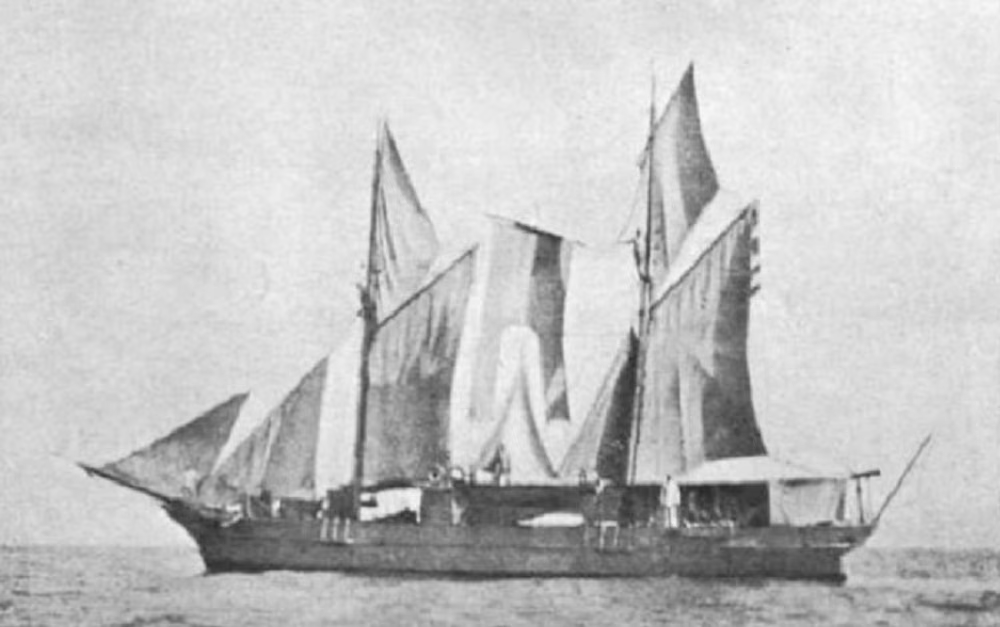
The steam-galley KICHLI, like the similar vessels KISSA and AIDON, served mainly in the Greco-Turkish War of 1897, while afterwards they took on chiefly auxiliary duties.
Written by Stefanos Milesis
In the «Dodecanesian Dawn» there was published in 1938 an unknown naval story belonging to the events that had preceded the war of 1897. The story was recorded by T. Vratsanos, who chose to publish it in a Dodecanesian newspaper of the time, since the protagonists of this naval episode were fishermen from Kalymnos. Although the story published that year concerned an incident that had occurred 44 years earlier, it cannot be ruled out that there had also been other, earlier accounts of it in other publications or in other versions. In any case, T. Vratsanos knew the true story, as he had heard it from Ioannis Vratsanos, an officer of the Navy, who had personally dealt with the incident.
The period in which the incident occurred (1896) was generally turbulent, with an atmosphere electrified by the belligerent mood that gripped the Greek people, who had overestimated the country's military value. The story, as it appears in the article by T. Vratsanos (in issue 404 of the «Dodecanesian Dawn» of October 1, 1938), is as follows:
In 1896 a telegram from the Port Authority of Thira to the Ministry of Naval Affairs reported that Coast Guardsmen on patrol had discovered a steam launch of unknown nationality, while as to its condition it was described as «dilapidated». The Minister of Naval Affairs at that time was Levidis, who hastened to dispatch to the island Sub-Lieutenant Ioannis Vratsanos in order to ascertain what exactly the matter was.
Vratsanos, after arriving at Syros by the line ship, embarked there on our fleet's steam-galley «KICHLI» bound for Thira. When he was led by the Coast Guardsmen to the shore where the «steam launch» had been found, he discovered with astonishment that the unknown vessel was not a steam launch but a gunboat!…
They had found it literally wedged between two rocks, with its bow resting on the sand. When the Coast Guardsmen discovered it, they climbed aboard but encountered no trace of a human being. The gunboat was in a state of abandonment; nevertheless, traces of blood had left their marks over almost the entire vessel, as though a real bloodbath had taken place upon it. On its deck, at the points where its cannons had previously been mounted, only their revolving pivots (their bases) remained. From all the interior compartments a foul odor arose, and even the utensils and furniture of the vessel were stained with blood! Yet no human bodies were found on the vessel, but everything indicated that a battle had taken place upon it with many dead.
The only living thing was a cat which, famished, wandered about the vessel, no one knew for how long. As the vessel leaned slightly to one side, in some places pools of blood had formed! Sub-Lieutenant I. Vratsanos could not determine the time at which the vessel had been abandoned, or under what circumstances this had happened. The only logical explanation was that the vessel, now deserted, driven by the winds and the sea currents, had at some point come to be wedged on the shores of Thira and thus become visible to people. The absence of a crew, combined with the blood-stained furniture and the pools of blood, pointed to its tragic end… Since, however, they could not draw a safe conclusion, Vratsanos proposed that the finding of the vessel be kept secret. The KICHLI received orders to fasten by night a towing cable to the deserted vessel and, always by night, to lead it to the naval station. Since not even there did they manage to extract any useful information, it was decided to remove from the vessel the cylindrical bases of its cannons and any other engine or deck fitting that could be of use, and after towing it once more to some point in the Saronic Gulf, they opened its flooding valves and left it to sink.
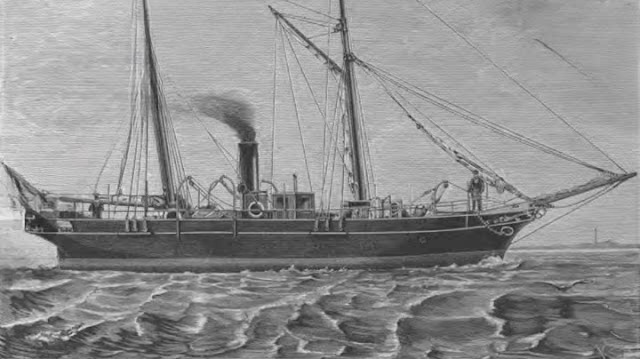
The mysterious vessel went to the bottom, dragging down with it the story that until then had not been revealed. A whole year passed after the incident and no one mentioned anything about it. Until, in 1897, and while in the meantime the Greco-Turkish War had broken out, two men dressed like the fishermen of our islands appeared at the door of the Ministry of Naval Affairs and insistently asked the sailor on guard to see the minister. «We are from Kalymnos» they said as soon as he received them, and they began to recount to him the following:
«One night, a year ago now, we were with our sponge-fishing caique out in the open sea, between Milos and Crete. Suddenly the searchlight of an unknown ship fell upon us and a voice called us to approach it. We, however, could not draw near the ship, as the weather was not favorable (the caique was a sailing vessel), and so we answered them that those who had an engine should approach. But when the unknown ship drew near us, we saw that it was a Turkish gunboat, and behind it, it was towing two boats full of Greeks whom the Turks had captured at sea. These were volunteers who were making their way to Crete to help in the cause of the Cretan revolution. Then we understood that they would take us captive too, and none of us, just as with the Greeks who were in the boats, could know his fate. We seized whatever we found at hand on our vessel, harpoons, knives, clubs, without being seen by the Turks who were approaching, and we said that, since in number we were equal to them, we would be the first to make the leap and come what may…».
As soon as the Turkish gunboat drew near the caique, the Kalymnian sponge-fishermen were the first to attack, taking the Turks by surprise, who believed that these too would surrender like the previous captives. As soon as the Kalymnians climbed onto the Turkish ship, they smashed the lamps and everything was plunged into darkness. Then a terrible struggle began upon the deck of the Turkish ship, where the blood from both sides flowed abundantly. The Kalymnians finally prevailed, freeing afterwards the Greek captives who were bound within the boats. It was they who unscrewed the two cannons of the Turkish ship and carried them to the Kalymnians' sponge-boat, along with whatever weapon was found. They asked the sponge-fishermen to carry them to Crete in order to help, as from the outset they had decided to do. The Kalymnians, however, did not know what they should do with the Turkish gunboat that had been left without a crew. So, after throwing the dead into the sea, they left it to its fate. The rebels did indeed reach Crete, while the Kalymnians for a year kept the secret sealed sevenfold. But when the Greco-Turkish War broke out, the Ministry of Naval Affairs announced rewards for those who inflicted any damage on the enemy during the naval struggle. As soon as the Kalymnians learned of this, they hastened to obtain the money to which they were entitled according to the announcement. Then the Ministry of Naval Affairs conducted an inquiry, taking testimonies from rebels who had been found bound in the boats of the Turkish gunboat. The inquiries showed that the Kalymnians' claim was just and that they truly ought to be compensated. The two Kalymnian seamen received, as representatives of the entire crew of the caique, the sum of one hundred and fifty thousand drachmas, which at that time was equivalent to one third of the value of the Turkish gunboat that had been rendered useless, as the relevant provisions stipulated.
I should, of course, note at this point that the «mystery» that shrouded the identity of the «unknown» vessel concerned only the circumstances that had brought it to the condition in which it was found (where, how, when, why). It is impossible to believe that when the ship was towed to the naval station they did not find, during the inquiries they conducted, evidence certifying its identity, that is, that it was Turkish. But because the situation of the two countries was tense on account of the Cretan uprising, and as ships were continually departing from Piraeus to reinforce the struggle of the Cretans (with the participation of the Greek state being, of course, unofficial), it was decided to make the traces of the gunboat disappear, since any disclosure of the incident would complicate the situation. When, however, the war of 1897 broke out, there was absolutely no reason to keep the incident in silence.
As to the fate of the KICHLI, which dealt with the incident of 1896, its fate is recorded on the website «Wreck History», at the link The wreck of the auxiliary KICHLI – Wreck History, as is the discovery of the sunken hull at Poros, in October 1946, by Giorgos Seferis.