The last (5th) naval campaign for the salvation of Messolonghi (20 March – 15 April 1826)
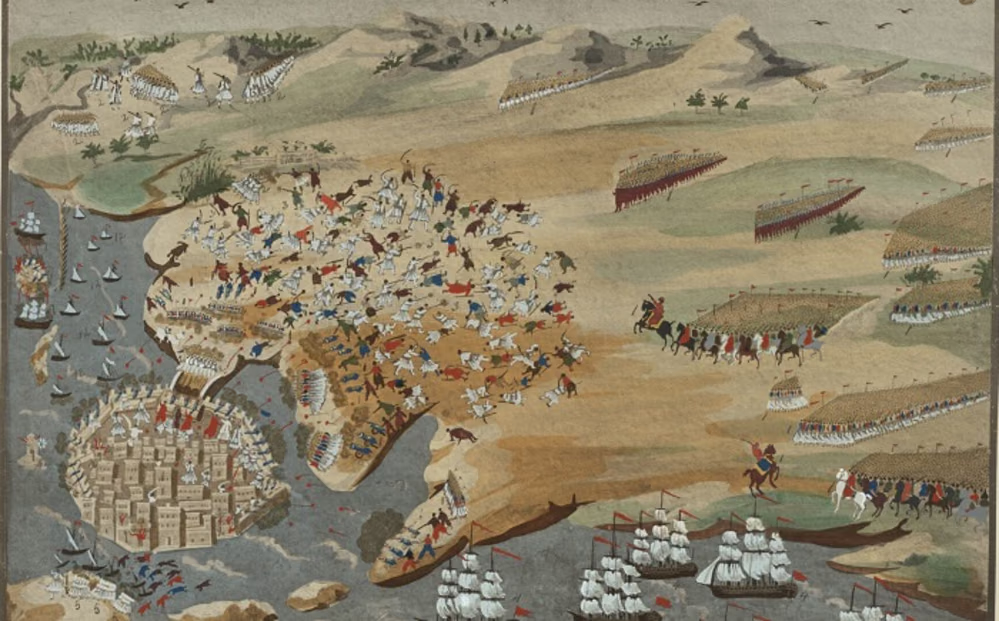
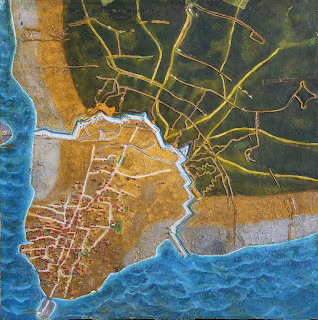
Ibrahim, having realised early on the strategic value of the lagoon for the defence of the city, launched coordinated operations from mid-February to seize its islets and to gain full control of all the approaches. From 17 February onwards, dozens of specially equipped boats of various types without keels, suitable for navigating its shallow waters, were gradually assembled in the lagoon, supported by an Egyptian steamship[2]. On the 20th of the month, about 50 warships sailed back to Patras from Methoni, where they had gone for repairs at the end of January. Two days later, Hussein Bey arrived at Messolonghi from Elis to take command of the landing operations.
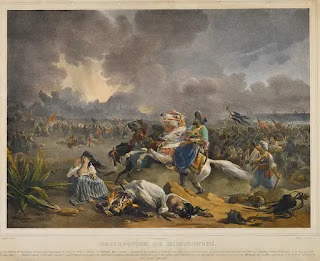
On 25 February, about 2,000 Egyptians under the leadership of Hussein attacked Vasiladi. The garrison of the islet, about 85 men with 14 cannons under Spyros Petaloudis, defended themselves bravely, refusing the offers of surrender. However, the accidental explosion of the powder magazine caused the collapse of the defence, the fall of the islet, and the death of Petaloudis and many of the defenders. On 28th February there followed the capture of Dolmas and Poros at the entrance of the town of Aitoliko. The garrison of the islets, 180-200 men under Grigoris Liakatas, facing enemy forces ten times their number of about 2,000 men, and despite the significant losses they inflicted on them, finally succumbed to the numerical superiority of their opponents, losing their leader and nearly all of their men. After the fall of Dolmas, on 1st March it was the turn of Aitoliko. The town surrendered and the roughly 2,500 civilians and the garrison of 300 armed men were transported to Arta and Preveza[3]. Ibrahim's successes in the lagoon were finally halted at Kleisova. There, on the 25th of March, the small garrison of the islet together with minimal reinforcements, in total about 150 men with 4 cannons under Kitsos Tzavellas and Panagiotis Sotiropoulos, repelled the massive enemy attacks of at least 6,000 men, Turks at first and Egyptians thereafter, inflicting on them about 2,000 losses, including Hussein Bey himself[4].
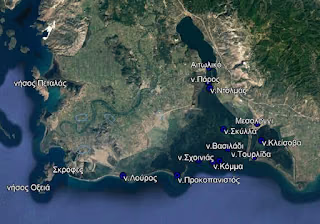
After the capture of all the islets of the lagoon with the exception of Kleisova, the blockade of Messolonghi became suffocating. Every possibility of supplying the besieged had now been cut off, and only the presence of a strong Greek naval force offered any hope for the continuation of the resistance. Insurmountable financial difficulties, however, prevented the swift manning and equipping of a numerically strong squadron that would be able to break the blockade and adequately supply Messolonghi[5]. The government's plan to mobilise 30 brigs, 11 fireships and 20 mystikos seemed, in those difficult circumstances, utopian. Finally, as time was pressing excessively, the necessary sums for the equipping and manning of the squadrons were gathered through emergency collections and contributions[6].
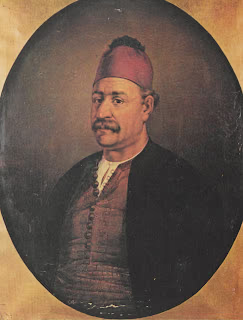
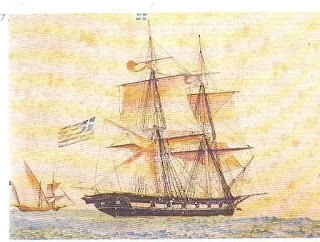
The Hydriot squadron, in total 13 brigs and 2 fireships, headed by the «Aris» of Andreas Miaoulis and the «Athina» of Georgios Sachtouris, set sail on the morning of Saturday 20 March 1826 from Hydra for Messolonghi, first passing by Spetses, where it arrived in the afternoon[7]. With it, it carried provisions and supplies for the «Free Besieged», the committee of the Messolonghians who had gone to Nafplio for talks, as well as 200 armed men under Theodorakis Grivas[8]. Given that the Spetsiot and Psarian ships were not yet ready, as were other Hydriot ones[9], the squadron, reinforced by the Psarian fireship of Konstantinos Nikodimos, set sail on the morning of 22 March for Vatika in Laconia, where it arrived in the evening. Over the next two days, the fierce bad weather scattered the Greek ships, which, following a westward course, began to reunite again off Neokastro on the afternoon of 26 March. During the three days that followed, the squadron learned the news of the fall of Vasiladi and Dolmas, the surrender of Aitoliko, the serious losses of the Turco-Egyptians, but also the insurmountable supply problems of Messolonghi. At midday on the 29th, near Kyllini, Sachtouris visited an English merchant brig coming from Patras. Its captain informed him that «the army of Ibrahim Pasha is in a wretched condition […] from hunger, that their provisions have almost begun to run out» and furthermore that the Turco-Egyptians had learned of «the Greek naval campaign of 80 ships […] and that thirteen thousand Greeks are coming by land to their aid»[10]. On the morning of the following day «a Thiakian bratsera from Petalas» informed Sachtouris of the great victory at Kleisova, while in the afternoon the squadron approached the island of Oxeia and sent to Messolonghi, by means of fires, the message of the arrival of the Greek fleet. The Greek ships confined themselves to the area of the Echinades, between the islets of Oxeia and Petalas, where 14 small boats with provisions for Messolonghi were also gathered, while 27 enemy warships controlled the sea area between Skrofes and Araxos.
The next day Sachtouris, with the delegation of the Messolonghians, «went out to Petalas» and sent «letters to Messolonghi, recounting to them the arrival of the Greek fleet, which brings with it munitions and provisions». Returning to his ship, the Hydriot vice-admiral conveyed to the crew positive news too concerning the diplomatic developments, since «Minister Wellington has departed unavoidably for Russia, and there together they are to speak concerning the independence of the Greeks»[11].
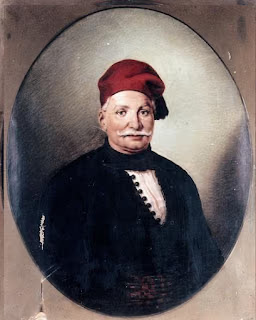
On the morning of 1 April, while the remaining ships that took part in the campaign also arrived in the area of the Echinades, it was decided at a council of the captains under Miaoulis to approach the lagoon by night and, with a local «kolaouzos» (guide), through a secret passage near Vasiladi, «to fill all the feluccas with hardtack and go and unload it there, and the Messolonghians with their dugout canoes would take delivery of it»[12]. The plan, however, could not be carried out owing to the presence of two groups of enemy ships, 36 from Kyllini and 12 from Patras, which were monitoring the movements of the Greek fleet and for an hour and a half in the afternoon clashed with it, preventing it from drawing near. The worst of it, however, was that in the waters of the Echinades «This night, by misfortune, 4 of our Fleet ran aground in the shallows» and were forced to throw into the sea 270 sacks of maize and hardtack, as well as precious munitions destined for Messolonghi, in order to be able to break free[13]. Early on the morning of the following day, the 48 Turco-Egyptian ships that remained on the line between Araxos and Kyllini exchanged cannon fire with the Greek fleet for about two hours. In the afternoon, at a second council of the captains, it was decided to load the provisions and supplies and to bring them out into the lagoon by night, towards the dawn of 3 April, with small boats accompanied by armed men, while the Greek ships would support the whole operation[14]. This attempt too, however, although well coordinated, failed because it was immediately detected by the enemy garrisons guarding the passages in the lagoon. At the morning council with Miaoulis, Sachtouris was informed of the letter from the Messolonghians that the admiral had received, in which the besieged reported that «the flour which the boats brought them the day before yesterday was all seized by the Turks, […] and they say that they have gone three days without food, and can scarcely hold out even today, if we do not get provisions to them in time»[15].
At 7:30 in the morning of 3 April, the Greek fleet clashed once more near the Echinades with the enemy fleet, in a final attempt, despite the unfavourable balance of forces, to break the blockade of the lagoon and supply Messolonghi. An attack by the Spetsiot fireship of Ioannis Kastelliotis on an enemy frigate failed, while the vessel suffered serious damage. The same fate befell the Hydriot fireship of Marinos Spachis, which in its attempt to set fire to an enemy corvette burned out to no effect. The unsuccessful attempt of the Hydriot fireship captain Georgios Politis to approach an enemy frigate after midday marked the end of the six-hour engagement. The Greek fleet, having 20 dead and 28 wounded, withdrew into the interior of the Echinades, while the Turco-Egyptian fleet withdrew west of Oxeia to the line between Skrofes and Kyllini, gaining full control of the lagoon.
It was now clear that this last naval campaign had failed to resupply the besieged city. The secretary of the «Athina», Nikolaos Tsiklitiras, notes characteristically in the log that «we fear that Messolonghi is going to bow its neck», while after the morning council of 4 April with Miaoulis, he reports that «our Vice-Admiral returned without news, but rather melancholy because he saw no means of helping Messolonghi»[16]. The Greek fleet remained henceforth confined to the sea area between the Echinades and Ithaca, unable to intervene decisively. On 5 April Miaoulis wrote to the notables of Hydra: «consider Messolonghi as lost, since we have no means to bring in food even for a short while, whereas the heroic and long-suffering garrison has been, by our reckoning, four days now without food […] do not overlook this general danger, but prepare as quickly as possible more fireships, and more ships, and send them to us»[17]. A similarly anguished report was sent the same day to the notables of Spetses by admiral G. Androutsos, who in his turn also requested immediate reinforcement of the fleet with fireships[18]. The tragic situation was confirmed also by the Himariot chieftain Christos Varfis from Messolonghi, who on the morning of 6 April visited Sachtouris on the island of Petalas, reporting «that for Messolonghi there is no longer any hope»[19].
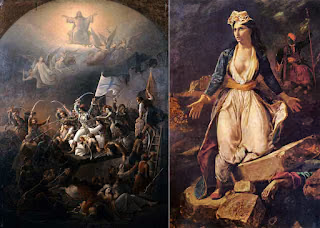
Although the written appeals from Zakynthos, which general Spyromilios conveyed to Miaoulis on Lazarus Saturday, 10 April, stated that «the nation rests upon the ships», calling on them «to stand with bravery, to lay waste the enemy, as on other occasions»[20], nevertheless the idea of withdrawing from the area began gradually to mature, given that the supplies were running out. At the morning council of Palm Sunday, it was decided that the fleet would remain temporarily and make one last attempt to resupply it from Zakynthos. In the meantime, however, the previous night the heroic sortie of the Messolonghians had already taken place, a fact of which the captains of the ships were unaware[21]. «The sorrowful news, that Messolonghi, on the 10th of the current month, at the break of Palm Sunday, three hours before daybreak, those in Messolonghi abandoned that fortress and made a sally» was brought on the morning of Monday 12 April to the crew of the «Athina» by boats that arrived at the island of Petalas. The news was confirmed also by Sachtouris on his return from the council of the captains with Miaoulis[22]. Having no further reason to be present in the area, the Greek fleet, after taking on board the 200 men of Grivas from Petalas, set sail for its bases, where it arrived on 15 April after a naval campaign of 27 days.
It was clear that under the specific conditions, the unfavourable balance of power, and with the minimal forces made available, the resupply and consequently the salvation of the city was something unattainable. Moreover, the untimely, adventurist undertakings during March, at Beirut and Karystos, tied up on secondary fronts 4,500 men and 20 ships that could, with better planning and coordination, have been made available for the salvation of Messolonghi, in combination with the 4,000 men of the external camp of Derveki (Analipsi of Trichonida). In the end, hunger and privation sealed the fate of the «Free Besieged». The repeated heroic efforts of the Greek crews and personally of Miaoulis did not succeed, but fate brought it about that the Hydriot admiral, with the frigate «Hellas», was the one to whom the honour fell, three years later (6 May 1829), to enter the now liberated Sacred City.
- all the dates mentioned refer to the old Julian calendar
BIBLIOGRAPHY
- History of the Greek Nation, volume XII, Ekdotiki Athinon, Athens 1975.
- Vakalopoulos Apostolos E., History of Modern Hellenism, volume VII, Vanias Publications, Thessaloniki 1986.
- Varsos Chronis, «The action of the Greek fleet in the Gulf of Patras (1825-1826). The naval mobilisation of the Greeks for the salvation of Messolonghi», Stratiotiki Istoria (Military History), issue 288, Athens 2021, pp. 34-47.
- Theofanidis Ioannis, The struggle for independence. History of the Greek navy September 1824 – April 1826. Neokastron – Kafireus – Alexandria – Messolonghi, published by «Naftiki Epitheorisi», Athens 1932.
- Kolombas Nikolaos A., Vasiladi. The Historic Islet – Key of the Lagoon of Messolonghi and the Naval Operations in the area during the period of the National Uprising. Its Brave Defenders, Union of Aetoloacarnanians of Peristeri «The Exodus», Athens 2010.
- Metallinos Konstantinos, The naval war during the Greek Revolution 1821-1829, volumes I-II, Andy's Publishers, Athens 2016.
- Michos Artemios N., Memoirs of the second siege of Messolonghi (1825-1826) and certain other notes pertaining to the history of the great struggle, Athens 1883.
- Sachtouris Georgios, Historical journals of the naval struggle of 1821, printing house of Kousoulinos and Athanasiadou, Athens 1890.
- Spyromilios, Memoirs of the second siege of Messolonghi 1825-1826, ed. Io. Vlachogiannis, Athens 1926.
- Trikoupis Spyridon, History of the Greek Revolution, volume III, London 1862.
REFERENCES
[1] Spyridon Trikoupis, History of the Greek Revolution, volume III, London 1862, pp. 309-310.
[2] These included lantzonia with one cannon and 30 soldiers, equipped small boats and launches with one cannon and 12 soldiers, gunboats and special rafts with one mortar. Artemios Michos mentions about 87 such vessels, while Ioannis Theofanidis limits them to 67. See Artemios N. Michos, Memoirs of the second siege of Messolonghi (1825-1826) and certain other notes pertaining to the history of the great struggle, Athens 1883, p. 46 and Ioannis Theofanidis, The struggle for independence. History of the Greek navy September 1824 – April 1826. Neokastron – Kafireus – Alexandria – Messolonghi, published by «Naftiki Epitheorisi», Athens 1932, p. 352 and Nikolaos A. Kolombas, Vasiladi. The Historic Islet – Key of the Lagoon of Messolonghi and the Naval Operations in the area during the period of the National Uprising. Its Brave Defenders, Union of Aetoloacarnanians of Peristeri «The Exodus», Athens 2010, pp. 98-100 and Konstantinos Metallinos, The naval war during the Greek Revolution 1821-1829, volumes I-II, Andy's Publishers, Athens 2016, pp. 468-469.
[3] Trikoupis, op. cit., pp. 325-328 and Kolombas, op. cit., pp. 102-110 and Metallinos, op. cit., pp. 470-471.
[4] Apostolos E. Vakalopoulos, History of Modern Hellenism, volume VII, Vanias Publications, Thessaloniki 1986, pp. 454-457 and Theofanidis, op. cit., pp. 362-367.
[5] There had preceded 4 naval campaigns to reinforce Messolonghi of brief duration in the wider sea area (15-26 July 1825, 13-28 November 1825, 2 December 1825 – 2 January 1826, 5-27 January 1826) and a more permanent one by a squadron of 7 ships during the period 26 July – 23 October 1825. See Chronis Varsos, «The action of the Greek fleet in the Gulf of Patras (1825-1826). The naval mobilisation of the Greeks for the salvation of Messolonghi», Stratiotiki Istoria (Military History), issue 288, Athens 2021, pp. 34-47.
[6] Metallinos, op. cit., pp. 476-479.
[7] Georgios Sachtouris, Historical journals of the naval struggle of 1821, Athens 1890, p. 181 and Metallinos, op. cit., pp. 480-481.
[8] The 6-member committee, which was composed of Chr. Koutsonikas, A. Iskos (who remained in Nafplio), L. Veikos, N. Zervas, A. Kousouris and Spyromilios, had set sail on 17 January 1826 from Messolonghi with the brig «Athina» of G. Sachtouris for Nafplio with the aim of informing the Government of the situation in the besieged city. See Sachtouris, Historical journals of the naval struggle of 1821, p. 177.
[9] These were 8 Spetsiot brigs and 4 fireships under admiral Georgios Androutsos and, in addition, 5 Hydriot brigs (among which the «Miltiadis» of G. Sachinis, which had loaded from Nafplio the main bulk of provisions and supplies for Messolonghi) and the fireship of G. Politis. The Psarian participation was limited to 2 brigs, 2 fireships and one mystiko. See Metallinos, op. cit., pp. 480-481. Another 13 Spetsiot brigs with 2,000 armed men under N. Kriezotis, V. Mavrovouniotis and Hatzimichalis Ntalianis had already set sail on 9 March for an adventurist campaign in Lebanon. During the same period another body of 2,500 regulars and irregulars under K. Fabvier had campaigned in Euboea with the naval support of 6 Hydriot-Psarian ships, attempting the capture of Karystos. See Vakalopoulos, History of Modern Hellenism, pp. 525-540.
[10] Sachtouris, op. cit., p. 185.
[11] It concerned the journey of the British general Arthur Wellesley, 1st Duke of Wellington, victor over Napoleon, to Saint Petersburg at the beginning of 1826 for talks with the new Tsar Nicholas I with the aim of a joint Anglo-Russian mediation in the Greek question. The talks finally resulted in the signing of the Protocol of Saint Petersburg (23 March / 4 April 1826), which provided for the establishment of an autonomous Greek state, tributary to the Porte. See Nikolaos Petsalis, «The position of the Greek revolution in the diplomatic field during 1826», in: History of the Greek Nation, volume XII, Ekdotiki Athinon, Athens 1975, pp. 436-437.
[12] Ibid., p. 189.
[13] Ibid.
[14] Ibid., p. 190.
[15] Ibid., p. 191.
[16] Ibid.
[17] Metallinos, op. cit., p. 488.
[18] Vakalopoulos, History of Modern Hellenism, p. 460.
[19] Sachtouris, op. cit., p. 193.
[20] Ibid., p. 196. Spyromilios had gone to Zakynthos to ask the British administration of the Ionian Islands to intercede with Ibrahim for the salvation of the civilians. Ibid., p. 193.
[21] In the sortie there participated about 3,000 armed men and 7,000 civilians, women and children. Remaining in the city, as the last focus of resistance, were 600 wounded fighters, the sick and the elderly.
[22] «It was told to his Admiral by the Commandant of the English Brig, which was anchored at Vasiladi». Sachtouris, op. cit., p. 197. It concerned the English brig «Chanticleer» commanded by Hope-Johnston. See also Metallinos, op. cit., p. 492.
Chronis Varsos (Philologist – Historical Researcher, M.A. in Modern & Contemporary History, Neapolis University Pafos)
The present article was published in the journal “ARDIN” (issue 137, March – May 2026)