THE POOR APOSTLES (Second Sunday of Matthew)
Fr. Dimitrios Bokos
The Pentecostarion has closed. The vast cycle of the movable feasts of Pascha, from the Sunday of the Publican and the Pharisee to the Sunday of All Saints, has been completed. We re-enter the ordinary flow of the liturgical ecclesiastical year. The reading of the Gospel according to John has ended, and last Sunday the reading of the Gospel according to Matthew already began.
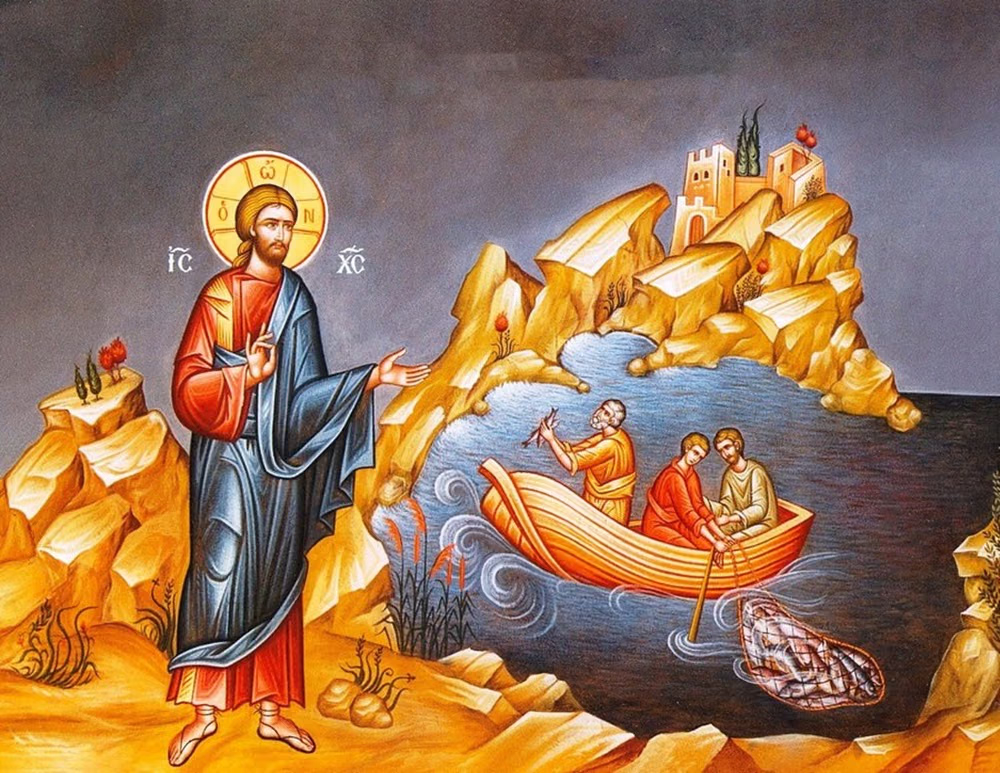
Today Christ calls his first disciples. Peter and Andrew, John and James, form the beginning of the apostles (Second Sunday of Matthew).
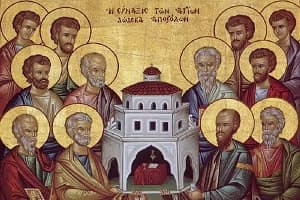
Little by little Christ completed the group of the twelve (12) and afterwards of the seventy (70) apostles. During the three years that he was with them, he took care to prepare them in every way for their great mission. He would also send them on brief tours to the cities and villages of Israel, so that they might be trained in apostolic activity.
He endowed them with the spiritual provisions necessary for their work, but he especially drew their attention not to be anxious about material things. «Provide neither gold, nor silver, nor brass in your purses». Do not carry wallets with money, he told them. Nor should you have a bag with provisions, nor two tunics, nor sandals, nor a staff. «For the workman is worthy of his food». Those for whom you labor will feed you (Matt. 10, 9-10).
Thus Christ ordained, «that those who proclaim the Gospel should live from the Gospel». He commanded that those who preach the Gospel should live from the support of those who hear the evangelical preaching.
The apostles, however, imitating the poverty of their Lord, generally made sparing use of this right. They made limited and discreet use of it, «giving no offence in anything», that is, avoiding every occasion of scandal, «that the ministry be not blamed». So that there might be no reproach, no accusation against their work, which was the preaching of the Gospel (1 Cor. 9, 12).
Thus, in order to be true ministers of God, so as not to provoke and scandalize the faithful, they lived frugally and poorly. «As poor, …as having nothing». They lived «in hunger and thirst, in fastings often, in cold and nakedness». In simple words, they hungered and thirsted, they were deprived of food, they found themselves in the cold without suitable clothing (1 Cor. 9, 14. 2 Cor. 6, 3. 10. 11, 27).
Paul in fact suffered more than all of them, because he did not wish to make any use of his right to live from the Gospel, that is, to be supported by the faithful. «I have coveted no man's silver, or gold, or apparel», he says. For my own needs and those of my co-workers, these very hands of mine labored. He worked in the small margins of his time as a tentmaker, so as not to create «any hindrance», not the slightest obstacle to the work of the Gospel (Acts 20, 33-34. 1 Cor. 9, 12).
The apostles regarded the love of money as the root of all evils. They called covetousness idolatry (1 Tim. 6, 10. Eph. 5, 5. Col. 3, 5). They especially urged their successors, the bishops, to be free from the love of money (1 Tim. 3, 3).
And indeed, throughout the ages, many of them imitated the apostolic spirit. Others, however, did the opposite. They regarded «godliness as a means of gain» (1 Tim. 6, 5). An opportunity to grow rich. But they went with their silver to perdition (Acts 8, 20).
And today? Does anything at all remain of the spirit of the apostles?
A deep skepticism already prevails over the scandalous, sudden benefits granted by the state to the leaders of the Church, at a juncture when the people are suffering. What is the purpose of this embrace? Does it aim at a political transaction and collusion?
And as for Caesar, well and good. He is doing his job. He creates his footholds wherever he can, in the way he knows.
But the ecclesiastical rulers? With what freedom will they act, and what right thing do they expect to do, harnessed with a golden bridle to his chariot?
A good and blessed week!