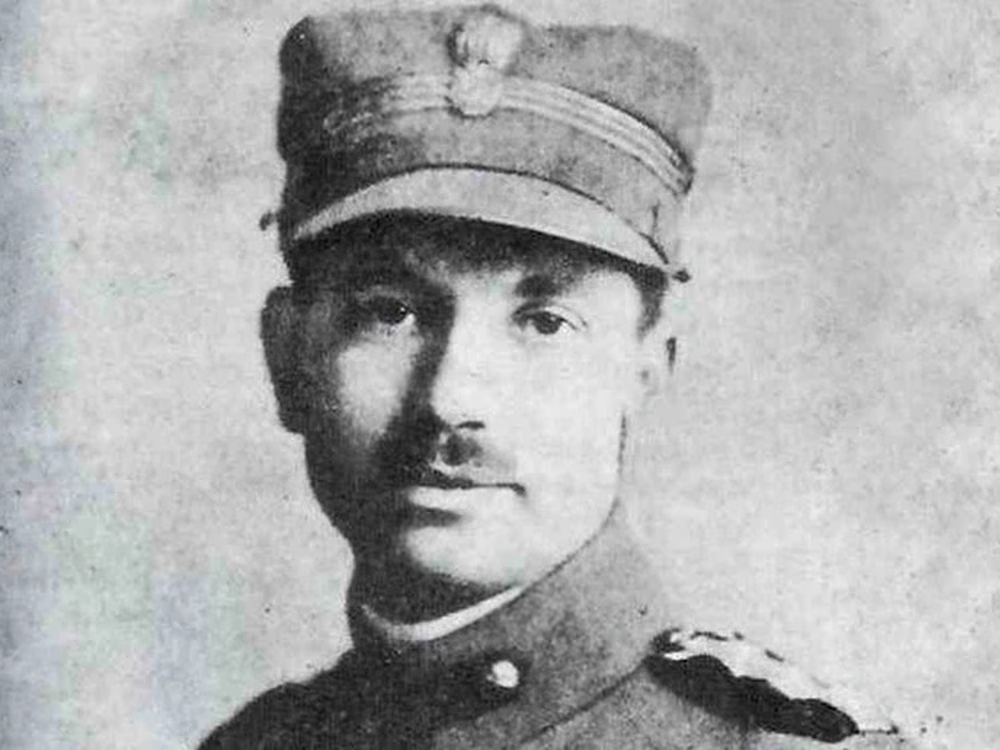
Colonel Psarros paid with his life for his love of Greece, Democracy and Freedom
Myrgiotis Panagiotis
Mathematician
 The National Resistance‧ a heroic page of modern history with very few stains. The Greek People, proud, democratic and free, could not endure slavery and subjugation. A double yoke, the German-Italian axis of Hitler and Mussolini. The Greek army fought bravely at the front, wrote pages of glory and heroism, but, it was defeated. Nevertheless, the epic of '40 remained in History.
The Greek cannot live enslaved; he wants to breathe air that is free, democratic and Greek. He decides to react; an armed struggle is needed. He begins to gather conspiratorially, and the first resistance groups against the double occupation begin to form. The first resistance organization to reach the mountains and sound the trumpet call of resistance is EDES-EOEA, led by General Napoleon Zervas. Later, others appeared as well, among them the organization EKKA (NATIONAL AND SOCIAL LIBERATION) of Colonel Psarros, which will concern us in the present work.
Psarros, a member of the Venizelist National Defence movement with experience from the battlefields, founded in May 1941, together with other reserve officers and civilians, the Greek Liberation Army (EAS), in coordination with the central military command, which was withdrawing from Crete to the Middle East. It spread across Boeotia, Fthiotida, Nafpaktia, Locris and the Northern Peloponnese.
On 20 April 1942 the organization merged organizationally with EKKA, and the 5/42 Evzone Regiment was re-formed, recalling the heroic Evzone Regiment. The organization developed quickly and was represented at the general allied military headquarters together with EDES and EAM.
Psarros' first cooperation with the British army took place on 29th September 1942, and the first battle against the occupiers on 18th December 1942. on the Erateini-Lidoriki road, where an Italian supply convoy was struck.
The KKE, on the pretext that members of the 5/42 Regiment were engaging in anti-communist propaganda, disarmed it twice. Let us see when and how.
The first dissolution took place on the night of 13 to 14 May 1943 at Stromi in Doris, where the Organization's headquarters were located, in the following manner. Aris Velouchiotis visits Psarros as a courtesy call and asks him for the passwords of his outposts because, supposedly, he wanted to move a unit of his through territory controlled by Psarros. The Colonel, acting in good faith, gives them to him, and thus he is caught literally and figuratively in his sleep. With the guerrillas of the 5/42 surrounded and the possibility of fratricidal bloodshed clearly visible, most of them surrendered and were disarmed. Psarros and his officers were arrested and the Regiment was dissolved. Through the intervention of the Middle East Headquarters (SMA), Psarros and his officers were freed. The arrest of Psarros and his officers provoked varied and intense reactions, with the KKE excusing itself by claiming that Aris Velouchiotis had been misled by "Captain Orestis" of the ELAS of Attica (Andreas Mountrichas), who was later accused of being an informer, agent and provocateur,‧ a common practice.
Around the end of May 1943, Brigadier Eddie Myers receives orders from the SMA to coordinate and reorganize the Greek guerrilla forces. The aim was to deceive the German forces in view of the Allied landing in Sicily. Psarros becomes active and gathers around him 200 fighters-guerrillas and began to receive weapon drops from the Middle East Headquarters, as (the then) Captain Athanasios Koutras mentions in his book. The last drop took place on 21st June, and the weapons had not been distributed to the fighters.
On the night of 22 to 23 June, the forces of EAM-ELAS attack the Regiment with the aim of dissolving it, as they had done a month earlier. The military objective failed. The armed ELAS forces were utterly defeated. They won, however, the "political" objective. After a few days the Colonel takes a decision that is difficult for me to understand: to dissolve the 5/42 Regiment, the military arm of EKKA. This decision caused sorrow and disappointed the brave men – the officers and ordinary soldiers. As Alex. Zaousis aptly wrote, "it was an act of excessive mildness in a struggle in the mountains, where passions had begun to run wild" (Alexandros Zaousis: The Two Shores 1939-1945, Athens 1987, Papazisis Publications, Part B(I), p. 287.)
Nevertheless, on the "29th of May the Middle East orders the 5/42 to be re-established, and Psarros returns to Giona. There, after a month, he is informed by a villager from Lefkaditi that '800 ELAS fighters of Nikiforos are coming to strike him.'." [Christos Zalokostas: The Chronicle of Slavery, Athens 1997 (reprint), Estia Publications, p. 217.]
Indeed, on the morning of 27th June 1943, 800 ELAS fighters with their officers arrive at the village of Lefkaditi, install a guard and a headquarters at the school, and summon the local cadres of the 5/42 Regiment to the school. They said that their objective was to strike Lidoriki.
Among the members of the local organization, the alarm was sounded. They suspected that the target was not Lidoriki, but, the 5/42 Regiment, which in those days was being reorganized and whose headquarters were very close by. It had established its Command Post at the location "Taratsa" of Giona.
The suspicions of the 5/42 cadres were quickly confirmed. The ELAS fighters in the schoolyard were drawing up their plans against Psarros. Small children were playing there, and the priest's son, a 9-year-old but shrewd boy, approached the guerrillas, feigning indifference, and there he overheard the plans of the ELAS fighters. The little boy informed his father, a local cadre of the 5/42.
Mitsos Koutras went uneasily to the school and overheard the exchanges of the ELAS fighters referring to Psarros. Quietly he made his way to a nearby house, where an ELAS officer was interrogating a Cypriot liaison of the Middle East Headquarters and trying to extract from him information about the 5/42 Regiment.
Koutras meets the village priest, Papa-Ilias Lakafosis; they brief each other and decide that Koutras should go to inform Psarros. They draw up the route plan and the excuses that Koutras will use if he is caught by an ELAS patrol.
With many precautions, and after seeing from afar a group of 70 ELAS fighters marching toward the headquarters of the 5/42 for a diversionary attack, at around 6th in the afternoon he finds himself with Psarros and informs him of what he had heard and seen. Psarros listened to him calmly and did not allow his feelings to be shown. He rejected proposals by officers for actions outside the defensive zone. He could not, or did not want to, believe that once again fraternal blood, Greek blood, would be shed. Finally he gives his orders to his officers and releases Mitsos Koutras to leave, advising him to be careful.
Perhaps the most apt description of the situation in which Psarros found himself is to be found in the book of C. Zalokostas: "Not even a month passes before a villager from Lefkaditi announces to Psarros that 800 ELAS fighters of Nikiforos are coming to strike him. By refusing to attack, the even-tempered Colonel irritates his officers" (Christos Zalokostas: The Chronicle of Slavery, Athens 1997, Estia Publications, p. 217.).
With the last light of 22nd June, the forces of ELAS set out to exterminate Psarros. Around midnight they draw near and put their plan into action. They hope to take him by surprise and send the EAM official at Lefkaditi, G. Krikelas, to deliver the ultimatum for Psarros' surrender. They realize the existence of manned advanced outposts of the 5/42, and so, instead of surprising Psarros, it is he who surprises them. Evidently Psarros rejects the ultimatum. The battle between the attacking ELAS and the defending 5/42 RE begins, and Greek human blood flows. ELAS chose to fight, once again, against Psarros rather than against the occupier.
The Psarros Regiment successfully repelled the attack of ELAS. The battle ended on the night of 23rd June 1943. The losses of the 5/42 were 3 dead and 5 wounded, while those of ELAS are characterized as "heavy". We note that the 5/42 fighter Ilias Tsigas, after being captured, although wounded, was executed by ELAS,. The captured ELAS fighters were all set free by order of Psarros. A great Patriot and Christian.
It is clear that the spirited and devoted fighting group of Lefkaditi not only saved the Regiment from a humiliating disarmament like that of Stromi, or perhaps from a surprise destruction of it, but also opened a brilliant road for the glory of Psarros.
Immediately after the battle, Psarros met the English Major Geoff and asked him to intervene so that ELAS would cease its attacks against the Regiment, and to reinforce it with certain resources that he indicated, so that the 5/42 could fulfil its mission. He also asked that the mediation and reinforcement take place as quickly as possible (in 2-3 days if possible), given that the units' distance from their supply bases created great difficulties in resupply. Otherwise, he declared unequivocally that he would dissolve the Regiment.
"After 4 days had passed, on 28/6/43, because not only was no answer given, but on the contrary Geoff showed complete indifference and remained inactive, Psarros, foreseeing the continuation of the bloodshed and the pointless mutual slaughter of the Greeks, decided to dissolve the 5/42 RE. Although victorious on the field of battle, he nevertheless chose to sacrifice a heroic effort for the liberation of the Homeland on the altar of reason and concord." (Georgios Kaimaras: The Chronicle of a Sacrifice, Dim. Psarros and the 5/42 Evzone Regiment, 3rd edition, Athens 1984, Sideris Publications, pp. 84-85.)
The Regiment was reconstituted, for the third and last time, at the end of August 1943. Once again officers and civilians hastened to join the Regiment, with far greater joy and enthusiasm than the other times. Colonel Psarros inspired them.
In September 1943, the Regiment began a heroic page of resistance in the mountains of Roumeli, fighting a series of battles against the occupier: the battle of Lidoriki on 12-13/9/1943, the battle of Skaloula on 14/9/1943, the battle of Anathema on 15/9/1943, the battle of Tsakorema on 19/9/1943, the battle of Vounichora on 25-20/9/1943, the battle of Zoodochos Pigi on 29/10/1943, the battle of the 51st km of the Gravia-Amfissa road on 11/1/1944, the sabotage at Dadi in Boeotia on 7/1/1944, and others.
The attack of ELAS against the EDES of Napoleon Zervas and the civil war of that winter (October 1943-February 1944) put the cohesion of the Regiment to a great test and ignited internal confrontations between its royalist and anti-monarchist officers, under the unbearable pressure of ELAS for the Regiment to abandon its neutral stance and to declare itself in favour of ELAS in its clash with EDES. In March and April 1944, a series of "local" incidents was ignited in Phocis, between the 5/42 and ELAS.
In mid-April 1944, the Regiment was methodically encircled by a large force of ELAS, led by Aris Velouchiotis, in the region of Trikorfo-Klima in Doris, at the very time when its – ever benevolent – Commander was trying to settle by political means the volatile situation that had been created in the last weeks. The battles reached their peak during Holy Week of 1944, especially from Holy Wednesday (12/4/1944). The Regiment repelled successive attacks of ELAS, culminating in the surprise attack of the Nikiforos-Papazisis Detachment from the direction of the village of Marathia toward the location "Skala Karaiskou" in Doris, against the Kaimaras and Koutras units of the 5/42, on Easter Day itself (16/4/1944).
This attack was repelled like the previous ones. On the same day Psarros dissolves the 5/42 and sends the last proclamation to EKKA and to the Middle East Headquarters. He writes that the accusations of ELAS against the Regiment "constitute a sinful pretext, inasmuch as the ulterior aim of EAM is to dissolve the Regiment, so that it alone may be master of the situation in order to impose its views."
At dawn on the 17th of April, the general attack of ELAS broke through the defensive line of the Regiment. Officers and soldiers find ways out and escape the slaughter. Colonel Psarros is the last to abandon the battle and descends to Skala Karaiskou, and he refuses to cross the Corinthian Gulf, believing that his presence among the prisoners would be beneficial to them. As for what followed, let us see how it is narrated by Professor Hagen Fleischer, who can by no means be counted among the "bourgeois" or "conservative" historians.:
"The tragic events of the 17th of April will constitute the darkest chapter of the Resistance. The victors killed, beyond the few who had fallen in battle, at least 66 guerrillas of the 5/42, many after horrific torture. Psarros too was executed, while dozens of his men joined ELAS in order to avoid the same fate. The testimonies converge that the execution was ordered by Colonel Efthymios Zoulas, but it is not clear who was the actual perpetrator of the cold-blooded execution of the captive Psarros. Zoulas ordered that on Psarros' grave they write: executed as a traitor of Greece.
The tragic death of (Psarros), after the dissolution of the 5/42 by ELAS in April 1944, convinced the bourgeois political forces that the KKE intended to seize power by force and caused them to rally against EAM." (History of the Greek Nation, Ekdotiki Athinon, Volume XVI, Athens 2000. Chapter Occupation and Resistance – Resistance and Civil Conflicts, written by Professor Hagen Fleischer, pp. 40/41).
Colonel Psarros Dimitrios, an officer of the Greek Army with combat experience, having taken part, as a volunteer, in the Balkan Wars, when he was only 19 years old and a student of the Faculty of Philosophy, a graduate of the Evelpidon Military Academy, a member of the Venizelist National Defence movement, fought and distinguished himself during the First World War and was wounded in the campaign in Ukraine. A patriot in every sense of the word, he did not want fraternal blood to be shed; his mind could not conceive of a Greek raising his hand against a fellow countryman at the very moment when the homeland, Greece, was groaning under the double occupation of two empires. The common struggle came first, that the occupier should leave and that the homeland should breathe the air of Freedom and Democracy.
Important battles in which the 5/42 Regiment took part (a simple mention). The year 1943
12-13 September: Battle against Italians and Germans at Lidoriki
15 September: Battle against Germans in the Anathema area
17 September: Battle against Germans in the Tsakorema area
The year 1944
11 January and 1 February: Battles of Gravia-Amfissa
With the present text we pay the least tribute of honour to Colonel Psarros, to his comrades-in-arms, and to all those who fought for the Democracy and Freedom of Greece.
Eternal be their memory.