20 June 1824 – The Destruction of Psara
Speech by the educator Konstantinos Vratsanos for the day of remembrance of the Holocaust of Psara
The destruction of Psara holds a special place among the sacrifices that the nation offered on the altar of freedom in the revolution of 1821. The great drama that shook the whole of Hellenism and moved the civilized peoples is among the unsurpassed examples of heroism and sacrifice, and it symbolizes the inexhaustible and unceasing fighting passion of the race.
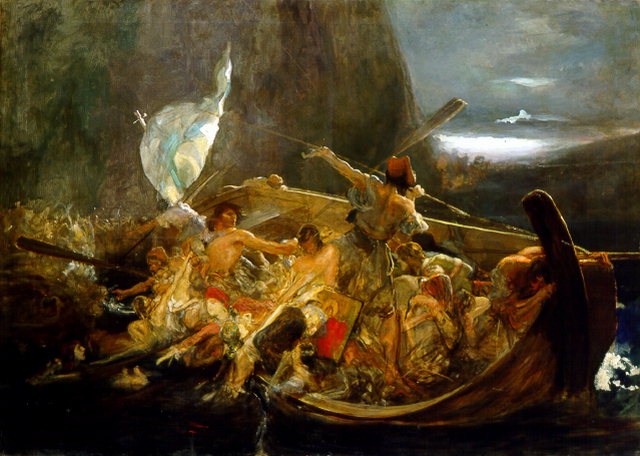
«After the destruction of Psara». Work by Nikolaos Gyzis
Amid the blue waters of the Aegean, like a huge isolated rock, the heroic and glorified island appears from afar. Cut off and somewhat remote, Psara is accompanied by its history. A history full of struggles, sacrifice and glory. Few are the historic places of Greece that radiate so much glory and stir in the visiting pilgrim so much emotion and so much reverence as Psara.
This land, in its entire extent, is drenched with the blood of its heroic defenders. Every stone is a feat, every shore a story.
The inhabitants of Psara from the earliest years turned to the sea, since the island, being mountainous, was not suited to other kinds of occupations. Quickly they began to build ships and to engage with complete success in commerce. The art of shipbuilding developed by leaps and bounds, so that with the passage of time it became equal to the European shipyards, with the result that many Europeans were left astonished on learning that these ships of the Psarians had been built by illiterate men who did not possess the necessary theoretical knowledge, but had as their measure of comparison their vast practical knowledge. The island experienced in that era a remarkable economic development, which was due to the industriousness and the courage of the Psarian sailors.
The merchant fleet kept growing and extended its activities to ever more and more distant places. It is characteristic that the revolution of 1821 finds the Psarians with more than 300 ships, of small and large tonnage, which sailed in all the seas bringing wealth to their island. Because on their voyages they were obliged to face pirates frequently, they armed their ships with cannon, which they were many times compelled to use. Thus very soon they acquired combat experience and later distinguished themselves as brave and experienced sea-fighters.
From 1770 the Psarians had armed raiding ships. Great was their military activity in the pre-revolutionary years. They carried out raids on the Turkish coasts, causing incalculable damage and securing material means for their better equipment and the more complete fortification of the island. While the whole of Greece groaned under the Turkish yoke, the Psarian ships with their heroic raids had become the nightmare of the sultan, and when the great moment of the nation's uprising sounded, the heroic island with its legendary fire-ships found itself from the beginning at the forefront of the struggle.
So when the long-awaited news of the revolution reached the island, after a doxology was held for the success of the struggle, they all joined their hands and their hearts and swore “FREEDOM OR DEATH”. From that moment the Psarians took an active part in the revolution and kept their oath to the end. On the very first day the action against the enemy begins. Now they no longer confined themselves only to surprise raids aimed at plundering and terrorizing the Turks, but undertook bolder ventures. The chief mission of the Psarian fleet was the pursuit and sinking of every Turkish ship that dared to cross the Aegean and the thwarting of every attempt of the sultan to transport troops by ship to revolted mainland Greece. This systematic and effective vigilance of the Psarians was the most important contribution to the revolution of 1821.
The fire-ships, small old vessels containing flammable materials, constituted the most fearsome weapon in the hands of the Psarians. These were placed against the sides of the enemy ships and, after fire was set to the fire-ship, it was carried over to the enemy ship and reduced it to ashes. When in 1822 the tragedy of the destruction of Chios by Kara Ali took place, ships from Psara rushed immediately to help. They managed to take aboard many inhabitants of the island, transporting them to Psara, to islands of the Cyclades and to other parts of Greece, saving them from certain slaughter.
But the vengeance for the destruction of Chios was not slow in coming. Konstantinos Kanaris is the man who undertakes the sacred mission. On his knees he worships in the holy church of Saint Nicholas, in the very place where we all stand today. Two Psarian and two Hydriot ships set out from Psara for the harbor of Chios, and on 6 June 1822 Kanaris's fire-ship sows ruin and destruction upon the flagship of the Turkish fleet, which is anchored in the harbor and celebrating the Bairam. More than two thousand men lay dead together with their leader Kara Ali. This great feat immediately became known throughout Greece and, as was to be expected, spread enthusiasm and raised the morale of the Greeks.
A multitude of other victories in naval battles and burnings of Turkish ships in various parts of Greece have as their protagonists Psarian sea-fighters such as Kanaris, Papanikolis and Nikodimos.
But the noose gradually began to tighten around the heroic island. Sorrowful messages reached the sultan daily about the action of the Psarians against the Turks. The burning of the Turkish flagship was the event that made the cup overflow and caused the sultan Mahmud II to scratch Psara off the map with his fingernail, wishing to show that this small island, which had caused him so many troubles, had to be utterly destroyed. Hüsrev Pasha undertakes the storming and destruction of Psara. This operation required large forces, because Psara had a strong fleet and good fortifications. For this reason he began to gather army and fleet at Sigri of Mytilene. From there the great onslaught would take place.
On the island everyone now feels the great danger and devotes themselves to fortifying it as well as possible, mainly on the southern and western coasts, since the northern and eastern coasts, with their steep and rocky shores, had a natural fortification. The Parliament of Psara takes up its role, which at that stage was the organization of the island's defense. Here we should note that on Psara at that time there was a most democratic administration. Every year elections were held in which all social classes took part, and 40 representatives were elected. These in turn chose the five elders (dimogerontes), who served without pay. So on the threatened coasts trenches and gun emplacements were built, and the army was organized, which had a total strength of about three thousand men. Of these, 1,300 were Psarians, 1,000 mercenaries from various places, and 700 settlers. After many discussions, the proposal to build a wall around the town of Psara was rejected, and the army was divided in order to defend the coasts from which the Turkish landing could take place.
The rudders were removed from the ships, proof that all would fight to the end, but also to satisfy the mercenaries, who feared they might be abandoned on the island in case of an unfavorable outcome of the battle. The sultan sends a message to the Psarians to surrender the island without war, offering guarantees for their lives. The answer is negative.
The great historic day was not slow in coming. On 20 June 1824 the Turkish fleet, consisting of about 200 small and large ships, made its appearance on the northern part of the island, at the bay of Kanalo. The attempts at landing begin immediately, and they were unsuccessful. All the Turkish attacks are repulsed thanks to the bravery displayed by the defenders. The next day the cannonade is fiercer, but again it does not bend the defense. However, the Turks find the eastern side of Cape Markakis not well guarded, and they give the signal. Little by little they disembark, climb the precipitous slopes, encircle the defenders at Kanalo and begin the murderous battle. Now waves of Turkish soldiers disembark, bending the heroic resistance that is put up.
The Psarians retreat and reorganize at the site of Ftelio, having previously inflicted very great losses on the attackers. But not even this last effort was able to stop the advance of the Turks toward the town. The Turkish troops, fanaticized by the heroic resistance they encountered and by the great losses they had suffered, on entering the town begin with fury the work of slaughter and destruction. The women and children run toward the quay to find salvation on the ships, while small groups of warriors continue the struggle even in this final moment. Some are slaughtered, others fall into the sea, others drown; fire and ashes everywhere. These are now scenes of biblical destruction. The savagery of the Turks is unprecedented.
Some ships finally manage to break out of the Turkish encirclement and save portions of the population. The rest meet a tragic death, except for those who gather at Mavri Rachi (Black Ridge) and shut themselves in the small fortress where the island's powder magazine also was. About five hundred people fight with admirable passion and bravery, inflicting very significant losses on the enemy. The fortress is bombarded from land and sea. After two days of heroic resistance, the battle now unfolds hand to hand. Then Antonios Vratsanos carries out the decision already taken. He sets fire to the powder magazine and the whole castle is blown into the air, dragging into death both defenders and attackers.
Psara, this naval bulwark of the Greek struggle, existed no more. On the island of wealth, of prosperity and of shipowners, on the island that gave everything, money and soul, for the sacred cause, ruin and destruction now reign. The holocaust of Psara, however, does not constitute a defeat, but immortal glory for Hellenism, which our national poet so worthily immortalized with his most famous epigram:
“On the all-black ridge of Psara, Glory walking alone, contemplates the shining brave lads, and on her hair she wears a wreath made of the few blades of grass that had remained on the desolate earth.”
It was the tragic epilogue of an unequal battle, a battle that proved in the most disarming way the ideals and the self-denial of the inhabitants of this heroic island. The Greek fleet, although it had been notified, arrives late and beholds a scene of horror. The news of the destruction of Psara shook the whole of Hellenism and made the European peoples look with greater sympathy upon the struggle of the Greeks for freedom and independence.
Konstantinos Kanaris, Nikolaos Apostolis, Konstantinos Nikodimos, Dimitrios Papanikolis, Antonios Vratsanos are some of the Psarian fighters who wrote their names in golden letters on the pages of glorious Greek history. Today we stand reverently at the monuments of the fallen, honoring with special magnificence the people who became a holocaust on the altar of freedom.
In an age when moral values are passing through a prolonged crisis, it is worth dwelling on historic moments like today's, in which brotherhood, bravery, self-denial, and sacrifice for ideals and freedom prevail. Today the “All-Black Ridge” rises before us. It is the sacred rock that will stand through the ages, a silent witness of the great sacrifice, an imposing and immortal monument of the holocaust, an eternal symbol of the unenslaved Greek soul.
From within the soul and the heart, from the mind and the conscience, there springs up today in the thought of all of us the great debt. And this debt is not only a national duty but also a privilege. The privilege of the Greek to build, through the ages, new Parthenons. It is such a historic past that compels us to move with all our strength and, through our peaceful works, to succeed in achieving a better tomorrow. Greece, a country with such a brilliant history and contribution to freedom and civilization, cannot but deserve a better future. And I believe that all of us are willing, at any price, to offer it to her.
Source: http://www.chiosnews.com
Republished from 20-6-2016