SAINT JEROME: THE GREAT ORTHODOX FATHER OF THE WEST
By LAMBROS K. SKONTZOS, Theologian – Professor
One of the greatest saints and Fathers of the Western Church is Saint Jerome. Of course, we are speaking of the era when the Church in East and West was united and Western Christianity was Orthodox. The Fathers of the Western Church of the early Christian centuries were, in sanctity and theological training, the equals of the Fathers of the East, and they contributed greatly to the development of the Church's self-awareness, to the clarification of the dogmas, and to the evangelization of the peoples who were in error and gross idolatry.
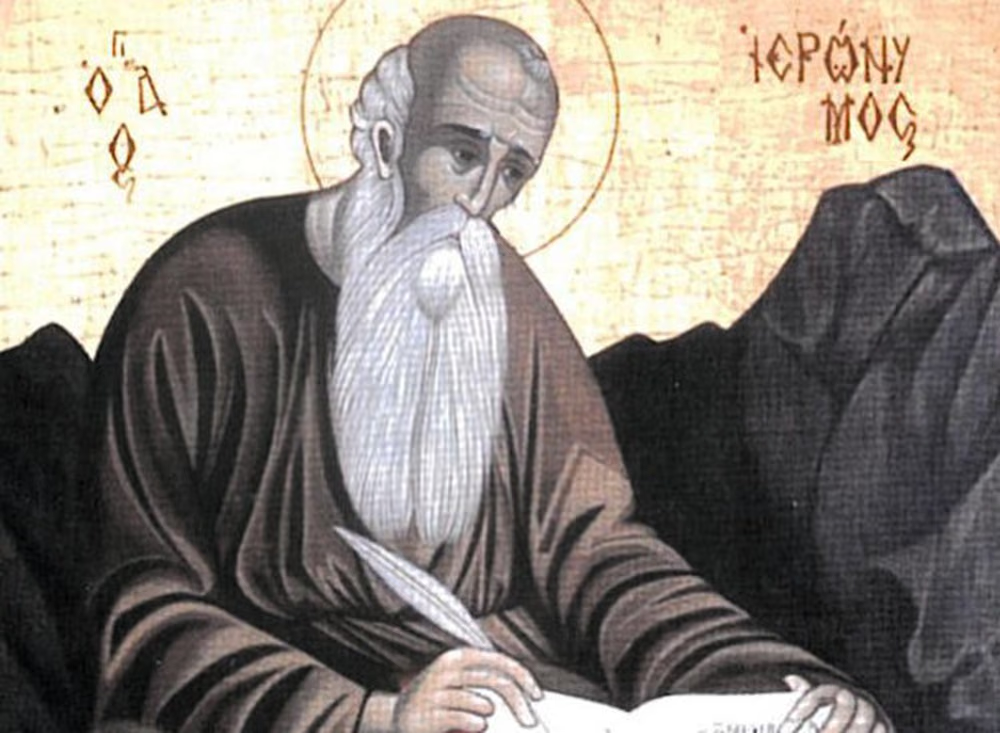
One of these Fathers, then, was Saint Jerome. He was born in 347 in the city of Stridon in Dalmatia and was of Illyrian descent. His parents, wealthy and devout Christians, gave him an education and inspired in him piety. At the age of only seven, they sent him to Rome to study literature and rhetoric, under the renowned teacher and philosopher Rufinus, with whom he was bound in friendship. He remained in Rome for fifteen years. Toward the end of this period he renounced his friendship with Rufinus and, along with it, the errors of Origen, which his teacher had embraced and taught. Subsequently Jerome, at the age of nineteen, was baptized a Christian by Liberius, Bishop of Rome. In 367 he went to Trier to continue his studies, and later, in 372, to the city of Aquileia near Trieste for the same reason. After completing his studies he turned toward the ascetic life, but the pleasures and temptations of life did not allow him to be initiated into and follow the monastic life. It is reported that for a short time he lived a dissolute life, over which brief straying he wept and lamented throughout his whole life.
In 373 he decided to visit the Holy Places where the Lord had lived, but when he reached Antioch he fell gravely ill and nearly died. There he became conscious of his sinfulness and repented bitterly for his dissolute life. After fervent prayer to God he was miraculously healed. This event became the occasion for him to devote the rest of his life to life in Christ and the service of the Church. He did not take the road toward the holy shrines, but the road of the Syrian desert, where through asceticism and prayer he was purified and sanctified. In 378 he returned to Antioch, where Bishop Paulinus ordained him presbyter, against his will, in 379. However, Jerome never approached the holy Altar, evidently because he considered himself sinful and unworthy of the great office of the Priesthood.
A year later, in 380, he went to Constantinople, where he met Saint Gregory the Theologian, as well as Saint Gregory of Nyssa and Saint Amphilochius of Iconium. He stayed near these great Fathers for about two years, where he was taught the Theology of the Greek Fathers and initiated into the genuine spirituality of our Church. During his stay in the Reigning City he learned Greek well, as well as the Hebrew language, in order to occupy himself with the interpretation of the Scriptures and the composition of theological treatises.
In 382 he went to Rome, where he became secretary to Pope Damasus until 384. He believed that he would be the next pope after the death of Damasus, but the slanders of the Roman clergy resulted in his not being elected to the episcopal throne of Rome. He was spiritually bound to three ladies of the Roman aristocracy, to whom he taught Orthodox spirituality and the ascetic life — Paula, Eustochium, and Marcella — who became the nucleus around which a multitude of other women gathered, to whom Jerome taught the Christian faith and the spiritual life.
Embittered, however, by the intrigues of certain Christians of the great city of Rome, he decided to return to the East, for he was drawn by the spirituality of the Christian East. His three disciples followed him. Thus in 385 he arrived in Bethlehem, the holy city where Christ the Savior of the world was born. With the money of his disciple Paula he built two monasteries near the holy cave of the Nativity — one for men, where he himself became abbot, and the other for women, where Paula became abbess. There he lived the rest of his life, as did his disciples, praying, exercising himself in virtue, studying, and writing important theological works.
He reposed on September 30, 420, and our Church ranked him among the choir of her saints and great Fathers. His memory is honored by the Orthodox Church on June 15, and by the Roman Catholics on September 30.
His literary work was great both in extent and in quality. His excellent knowledge of the Latin language made him one of the most important Latin writers. He worked chiefly as a translator of the works of the Greek Fathers into Latin, thus contributing to the acquaintance of Westerners with Eastern Theology. He also wrote exegetical, dogmatic, and anti-heretical works. A large number of his letters have also been preserved. His most important work, however, is the translation of the Holy Scripture into Latin, which is known to us as the Vulgate, that is, the common, popular version. As for his teaching, it continues the tradition of the great Fathers of the ancient Church — Ignatius, Irenaeus, Cyprian, and the Cappadocian Fathers. His entire theological system is summed up in the principle that the salvation of man is accomplished only within the Church, while outside of Her there is perdition, separation from God, and death.