Sacred festivals, or for the sake of the festivities?
(an Orthodox Christian approach)
by Protopresbyter Fr. Panagiotis N. Michos
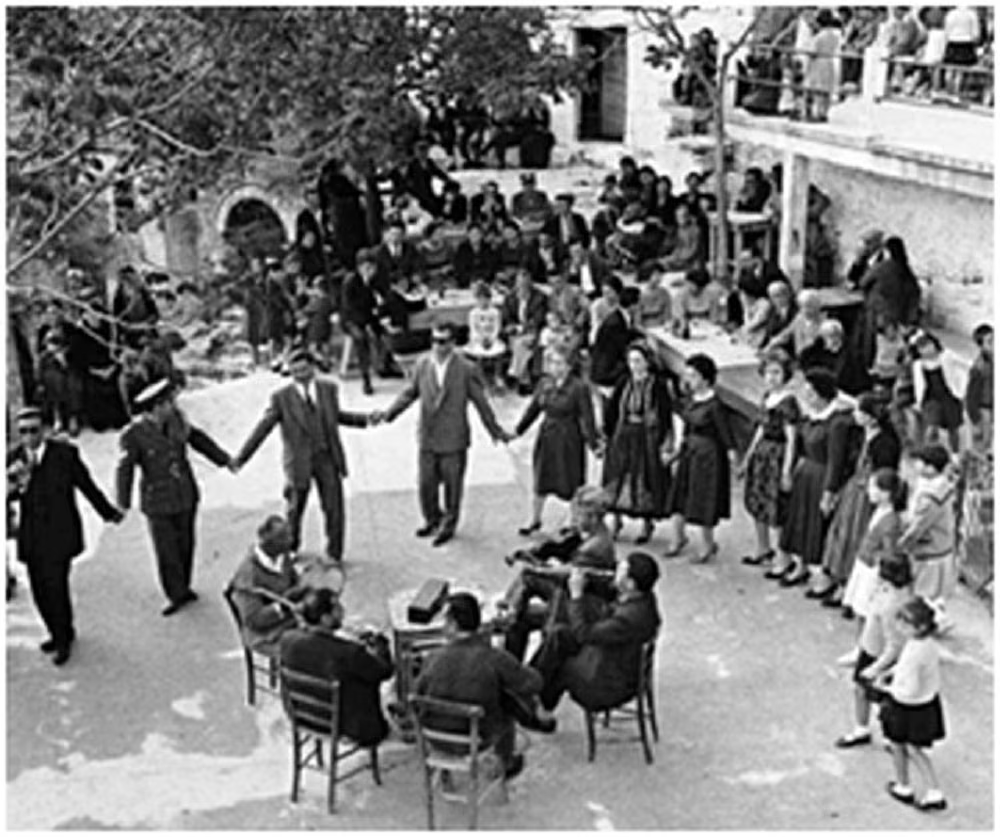
In all the manifestations of social life, the Christian person has always learned to combine the sacred with joy, the Church with Tradition. Let us not forget that our Christ too took part and worked His first miracle at the joyful celebration of newlyweds at Cana, blessing the social dimension of the mystery of marriage. In our own cultural and religious identity, the traditional festivals are inextricably bound up with the commemorations of Saints or of other great feasts of Orthodoxy. On the occasion, for example, of the feast of Saint Kyriaki, people gather and, after attending the Liturgy, express their joy and keep the tradition with dance and song. Rarely in the Greek lands will we encounter festivals held on other pretexts, e.g. a sardine festival, a garlic festival and so on. These are characterised as "forms of modernism," according to Em. Varvounis, professor of Folklore at the University of Thrace.
Cultural events based on the Christian feasts ought to be organised under certain conditions. The aim, according to Saint Porphyrios, is the experience of the common resurrection and the unity of the community. The going out from the ego to a meeting with the "we," especially in periods when communities are struck by the abandonment and indifference of the official state, as well as by other extreme conditions, cf. the Daniel flood.
Moreover, all the expressions of daily life are sanctified — and must be — whether in joy, in dance, in song, in food. The Apostle Paul stresses that whatever we do, we should offer it up with thanksgiving to the heavenly Father (1 Cor. 10, 31). The festival, according to Saint Paisios, when it is confined to trade, food and revelry, turns into an idolatrous celebration. And many Christians who try to reconcile worldliness with the Church resemble the one who wished to serve two masters.
Alienation and corruption of the original pure and blessed spirit of the festivals came about with the shifting of their organisation from the parish and the community to the various associations. With a view to securing sponsorships from public bodies, which will exploit them for vote-mongering by making the rounds and handing out lavish smiles to the naive people, everyone is happy. And never mind that the fast is trampled upon. And never mind that they urge people, until the small hours, stuffed with grilled meats and alcohol, not only to abstain from Holy Communion, but not even to be able to go to church to light a candle. If we want to be called Christians, if we want to serve the tradition authentically, things have a specific order. Wholehearted preparation, participation in the divine worship and in Holy Communion. And the rest of cultural and social life follows.
If we possess sensitivity, and the prophecy of Isaiah (ch. 29, v. 13) is not confirmed: "This people draws near to me only with their mouth and honours me with their lips, but their heart is far away from me." Would it be wrong?