The Crypto-Christians of Spathia in Elbasan
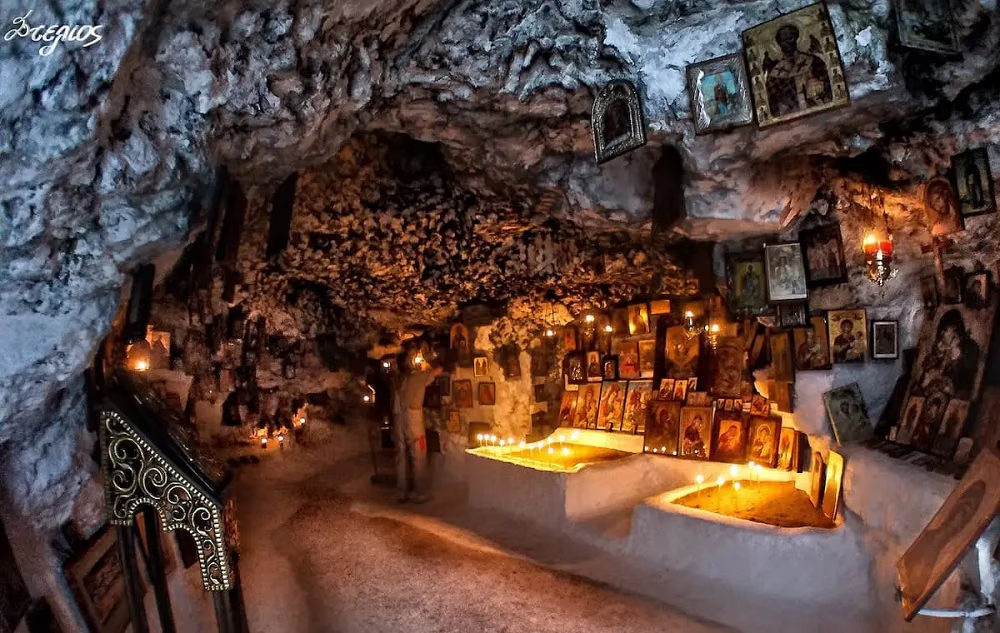
The history of crypto-Christianity in the Balkans brings to light rare aspects of resistance against Islamization. In the region of Spathia, the inhabitants outwardly adopted the Islamic way of life, while secretly preserving their Orthodox faith.
With the consolidation of the Ottoman Empire, several populations in the Balkans, as well as in the region of Epirus and Albania, suffered fierce persecutions and torture. Especially in Epirus, as it is known in world historiography (without taking into account the present-day states in the Balkans), the fury of the Ottomans against the Christians was intense, since the Byzantine Prince George Kastriotis had staunchly resisted the Sultan, managing for several years to remain free in his principality.
For this very reason the Ottoman Turks set about with a frenzy the Islamization and the multifaceted destruction of the people of Epirus. Thus many Christian populations in Epirus, and further up, in Albania, were Islamized en masse in order to continue to keep their lands and the rest of the privileges they had held before the Ottoman onslaught in the region. And yet, amid these social upheavals and changes, there were also populations that continued to preserve their Orthodox faith, while outwardly having adopted the Islamic way of life.
One cradle of crypto-Christianity was the administrative district of Spathia and Souliava. There the inhabitants outwardly became Muslims and for a considerable time remained crypto-Christians. According to Pouqueville, a part of Souliava, one third of its population, remained crypto-Christians until the first decades of the 19th century, something which is also corroborated by their correspondence with the then Metropolitan of Belegrada (Berat), Anthimos Alexoudis.
The region of Spathia is located on the western side of Mount Spat, between the Genousos (Shkumbin) River, the Devoll River and the Apsos (Seman) River. In Byzantine times this place belonged to the province of Eordaioi, while today it falls under the prefecture of Elbasan. The name of the region probably derives from the large swords (spathia) of the Greeks which the inhabitants of the region had kept, or from the Albanian word "shpat" which means steep mountainside.
The well-known French Hellenist Bérard also mentions that inhabitants from Spathia migrated to many parts of Greece, from Thessaly to Patras. Meanwhile the Greek consul, in a telegram to the Ministry of Foreign Affairs in April 1911, reports that among a group of armed Ghegs arrested in Delvino there were also many Spathiote Orthodox Christians from the region of Elbasan, who worked on road construction in Greece, as well as on other agricultural labour.
As for the villages with crypto-Christians, they number up to 43. Kosmas the Thesprotos, around 1823–1833, speaks of 30 villages, while in a report by a trustee of the Metropolis of Belegrada, only 13 villages are mentioned. In 1890 the consul of Berat, D. Somakis, in a report to the Greek Embassy, speaks of 24 crypto-Christian villages. Meanwhile a relevant article in the newspaper "Neologos" in Constantinople mentions 42 villages. The inhabitants of these villages took the decision to publicly confess that they were Christians, as reported by the Austrian vice-consul in Durrës, Winter.
However, the Turkish administration of the region demanded that they be enlisted as Muslims. The custom of these inhabitants had the men bear Muslim names or even be partly Islamized, while the women, who usually remained at home, stayed more consciously attached to Orthodoxy. The subject of the crypto-Christians of Spathia is quite profound and continues to constitute a historical testimony of resistance during Ottoman rule in the region.