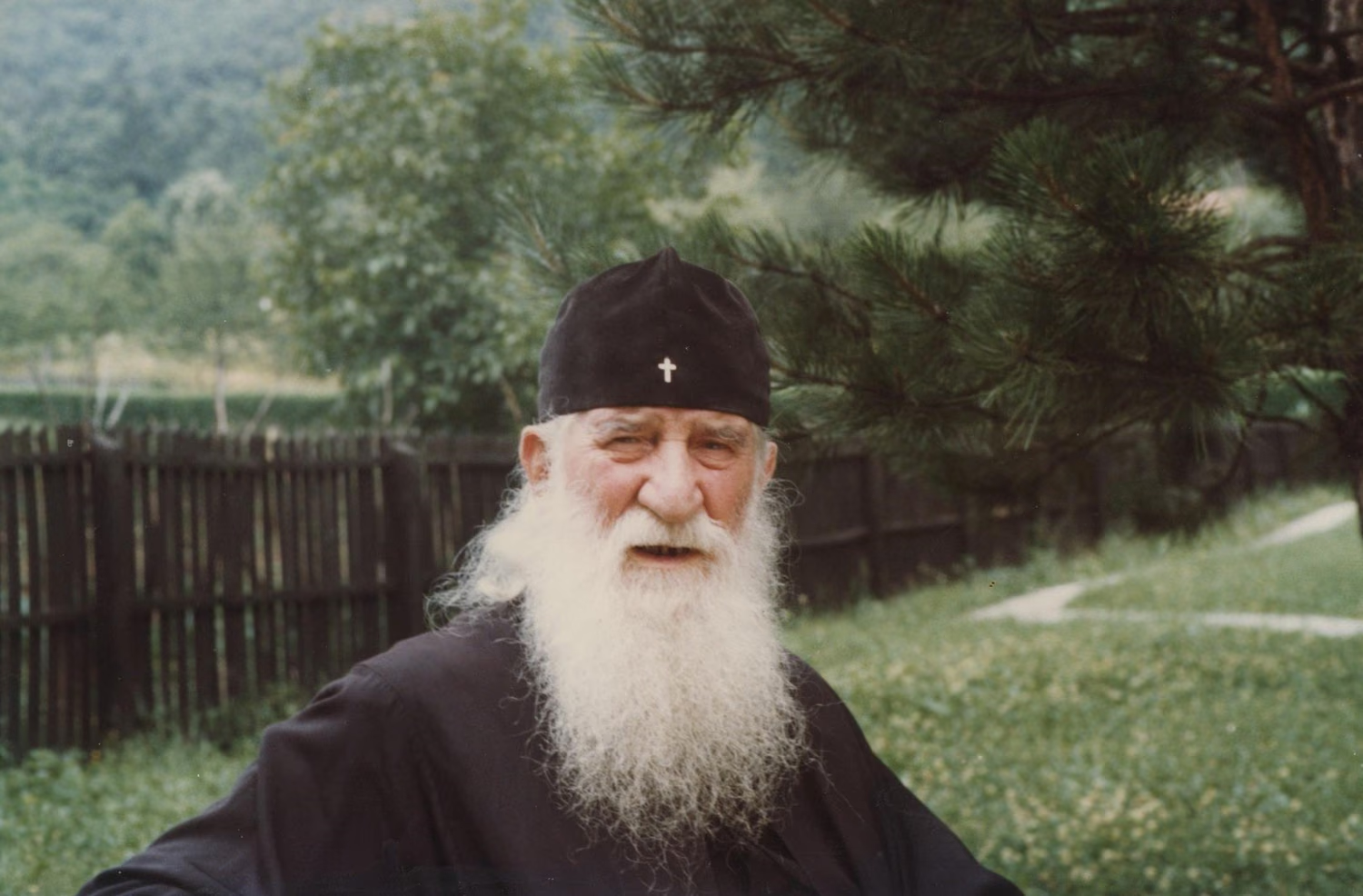
St. Justin Popović: The Great Contemporary Father and Teacher of the Church
BY LAMPROS K. SKONTZOS, Theologian – Teacher
Serbian Orthodoxy has a series of great saints to show, who have shed luster upon the Church of Saint Sava. One of them was the newly-revealed saint Justin Popović, a truly great ascetic and patristic figure of the past century.
He was born on the day of the Annunciation in 1894, in the town of Vranje in southern Serbia. His pious parents, Spyridon and Anastasia, gave him the name Evangelos. He came from a priestly family, and his surname, Popović, means "son of a priest." He grew up in piety and had the good fortune to see his mother miraculously healed at the Monastery of Pčinja by Saint Prochoros. From an early age he was accustomed to studying the Gospel and other ecclesiastical books. He was especially captivated by the reading of the lives of saints and patristic writings. He regarded the Fathers of the Church as the true wise men.
In 1905 the young Evangelos enrolled in the Ecclesiastical School of Saint Sava in Belgrade, having as his teacher the enlightened Saint Nikolaj Velimirović. In 1914, just as he finished the school, the First World War broke out. He enlisted in the army and served as a medical orderly. He followed the fate of the Serbian army and found himself exiled to Corfu. Along the way he felt the calling to become a monk. His tonsure took place on the 1st of January 1916 in Shkodra, by the Metropolitan of Belgrade Dimitrije, who gave him the name Justin.
Afterwards he left Corfu, with the help of Metropolitan Dimitrije, for Saint Petersburg to pursue theological studies. However, due to political developments, he left for Oxford. After two years of studies he submitted for approval his doctoral thesis, entitled: "The Religion and Philosophy of Dostoevsky." This, however, was rejected, on account of his criticism of the errors of Western Christianity and his defense of the Orthodox Dostoevsky.
In 1919, after the end of the war, he returned to his homeland and was appointed professor of theology at Sremski Karlovci. He soon resigned and moved to Athens to continue his theological studies. In 1926 he received a doctoral degree in Patrology, on the theme: "The Problem of Personhood and Knowledge in Saint Macarius of Egypt." At the same time he learned to speak fluently Old Church Slavonic, Ancient Greek, Latin, Russian, Modern Greek, English, German, and French.
He then worked as a professor at the Ecclesiastical Schools of Karlovci, Prizren, and Bitola (Vitola). In 1930 the Serbian Church sent him to Czechoslovakia for missionary work among communities of Orthodox Christians who had renounced the Union (Uniatism). His work there was great, and for this reason he was elected Bishop of the newly-established Diocese of the Carpathians, a dignity he did not accept out of humility.
During the German occupation he found himself in a sorely-tried Serbia, moving about among various monasteries. At the same time he had been appointed professor at the University of Belgrade. However, with the prevailing of communist power in 1945, persecutions against the Church began. Two hundred professors were expelled from the University of Belgrade, and among them Justin. He took refuge in the Holy Monastery of Sukovo near Pirot in southern Serbia. In 1946 he was also imprisoned. Later he was tried and sentenced to death as an "enemy of the people"! He was saved thanks to the intervention of Patriarch Gavrilo, who had just returned from Auschwitz and demanded his release.
However, persecuted from everywhere, without a pension and deprived of elementary rights, he found refuge, as a spiritual father, at the women's Monastery of the Archangels in Ćelije near Valjevo in southern Serbia. Naturally, not even there did he find peace, for the atheist Marxists watched him incessantly and frequently subjected him to grueling interrogations in Valjevo. He was almost confined within the Monastery, because he was forbidden to leave without permission from the authorities, especially when the Holy Synod was in session, so that he would not come into contact with the Bishops and influence them.
The confined Justin, despite the prohibitions, the exhaustions, the intimidations and threats, prayed unceasingly and lived a strict ascetic life. He performed all the services of the day and night without fail. He celebrated the Divine Liturgy daily and fasted (ate nothing at all) every Friday, during the first week of Great Lent, and during Holy Week. He commemorated hundreds of names daily in the Divine Liturgy.
His strict confinement, however, was no obstacle to his becoming known throughout the world. Thousands were the letters he received, and thousands too were his visitors, from Serbia and all over the world. When he remained alone in his humble cell, for 28 years, he wrote his most profound writings unceasingly. He reposed peacefully — not by chance — on the day of the Annunciation, the day of his birth, on the 25th of March 1979. The translation of his holy relics took place in 2015 and constituted a momentous event for the Serbian Church and all of Orthodoxy. Everyone sensed the ineffable fragrance that issued forth from his tomb! The Serbian Church proclaimed him a saint, and his memory was appointed to be honored on the 14th of June.
Saint Justin Popović belongs among the great priestly and theological figures of the contemporary Church, on a par with the great Fathers of the ancient Church. His theological discourse is pure, Orthodox, grounded in Holy Scripture and the Fathers of the Church. He is the theologian of the God-Man (Theanthropos), who, in a marvelous patristic style, theologized with astonishing precision concerning the redemption of the human race in the God-Man. He was a consistent Orthodox Christian and denounced heresy. With clear reasoning he demonstrated the heresy of Papism and Protestantism as an absolute degeneration of saving Orthodoxy. He was particularly critical of the modern scourge of Ecumenism, which he characterized as a "pan-heresy." He bequeathed to us a great number of profound theological works, on a par with those of the great Fathers of our Church, many of which are also circulated in the Greek language.
The newly-revealed saint Justin is the great proof that the presence of the saints in our Church is continuous and unceasing, unto the last days. He reveals the perpetual miracle in the life of our Church!