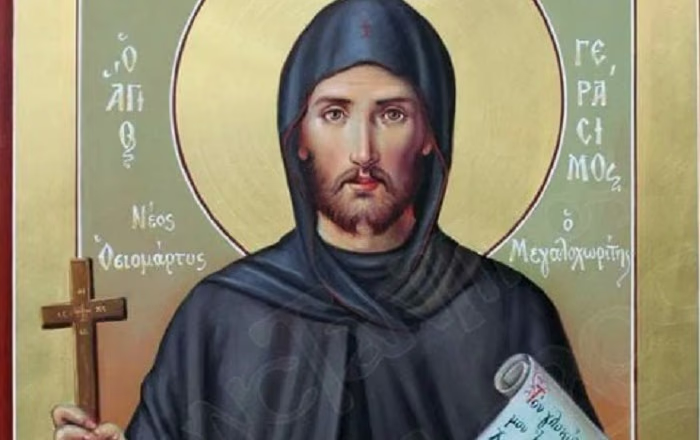
Saint Gerasimos the Venerable Martyr of Megalo Chorio
By LAMPROS K. SKONTZOS, Theologian – Teacher
During the years of the Turkish occupation, the Agrafa region became a cradle for the cultivation of freedom and the Christian faith, owing to the peculiar character of its terrain. In the wider area many saints and Neomartyrs arose. One of these was Saint Gerasimos the Venerable Martyr of Evrytania.
He was born at the end of the 18th century in Megalo Chorio in Evrytania to pious parents, and his baptismal name was George. Because of poverty, when he was eleven years old his brother Athanasios took him to Constantinople and placed him as an assistant in the grocery shop of a fellow countryman of his. One day his master sent him to sell yogurt in earthenware pots, which he had placed on a tray. But, through the working of the evil one, as he walked along crying out his wares, he stumbled on a stone, the tray fell, all the earthenware pots broke, and the yogurt spilled. Little George sat down in a corner and wept bitterly, fearing the consequences from his ill-tempered master. From a window across the way a Turkish woman, the wife of a renowned agha, saw him; she took him into her house, consoled him, and promised him that, if he wished, she would make him as one of her own children.
In the Turkish household George was impressed by the luxury and the comforts, and after two months he consented to be circumcised, which means that he was converted to Islam. He now lived as a Muslim and enjoyed the comforts of the wealthy house. Indeed, he had won the love and favor of the agha, who, after two years, handed him over to another high-ranking official who, on account of his duties, traveled throughout the Balkans, keeping George with him as his faithful servant.
After a long journey they returned to the City, and at a certain moment, in a wondrous manner, he became aware of his great error in having denied his faith in Christ and embraced the religion of the conquerors. For this reason he decided to depart secretly for his homeland, where, with contrition and repentance, he confessed to the priest of his village and returned to the Church. He would frequent a ruined country chapel of Saint George, half an hour outside the village, where he prayed for hours and wept unceasingly. Many nights he spent praying and lamenting in the country chapel.
After three years of utter contrition and repentance had passed, he decided to go to Mount Athos, to the Skete of Saint Panteleimon, and he submitted himself to a virtuous elder, Kyrillos, who counseled and consoled him. He also taught him a little reading so that he could read soul-profiting texts. He was especially fascinated by the “New Martyrology,” which contained the heroic martyrdoms of the Neomartyrs. After a year, he asked Kyrillos to be tonsured a monk. The elder had his reservations, because the period of probation had been short. For three months he entreated him with tears. In the end he permitted it, and he received the monastic habit and the name Gerasimos.
After three months he made known to the elder his decision to go and be martyred, in order to wash away his great sin. The elder feared that this was a demonic temptation and tried to dissuade him, setting before him the difficulties of martyrdom and the danger of a fresh conversion to Islam. The other fathers of the Skete likewise sought to dissuade him. Gerasimos would return to the matter from time to time, but he received a negative answer. This lasted three years. One day Gerasimos asked for their blessing to go to his homeland. They understood that he was asking to go to his own native place, but he meant the Heavenly Jerusalem. And so they gave him their blessing.
He set out at full speed for Constantinople and went to the house of the agha, where he stood before him and confessed that it had been a childish error of his to convert to Islam, and that now, having grown up, he had turned back again to faith in Christ, the true God; that he had left the darkness and found the light. The agha, dumbfounded, began to counsel him that this act of his was dangerous, and that if he became a Muslim again, honors, offices, and riches awaited him. For three days the agha tried to change his mind. But in vain: Gerasimos had made his decision, to shed his blood for Christ. The agha, a man of good disposition and because he loved him, advised him to flee secretly to a foreign land and save himself. But Gerasimos remained unpersuaded. Then the agha handed him over to a sheikh to take charge of persuading him. But again Gerasimos remained firm in his resolve, and so he handed him over to the Turkish judge, before whom he once more confessed his faith in Christ.
Those present rushed upon him like bloodthirsty beasts and beat him savagely. Then they shut him in prison and placed a boulder upon his chest. He remained there ten days, without suffering any harm! Then they interrogated him a second time, but Gerasimos declared aloud, with all the force of his voice, that “My most sweet Jesus Christ I will never deny, even if you condemn me to a thousand deaths”! The judge, enraged, pronounced the sentence: death by beheading!
The executioners took him and led him to Baba Humbai, near Hagia Sophia. On the way they urged him to convert to Islam in order to save himself, but the saint paid them no heed. He asked forgiveness of the Christians passing by. At the moment of the execution he was asked to kneel. The Martyr cried out: “Remember me, O Lord,” and the executioner cut off his head, which remained smiling for an hour, while his body remained kneeling for a quarter of an hour! A heavenly light shone above the sacred relic! It was the 3rd of July, 1815. He was but 25 years old. The Christians purchased his body and buried it with honors. A short time later the learned Evrytanian cleric Kyrillos Kastanofyllis transferred it to the Holy Monastery of Prousos. His memory is honored on the 3rd of July.